
Parents hear two stories. One says a kid who wants to pitch in college needs baseball all year, or he will fall behind. The other says multi-sport athletes are healthier and better in the long run. Both stories contain some truth, and the research helps sort out which one holds over a career. This article walks through the main studies, their limits, why playing other sports might help a pitcher learn, and how to fit a second sport into a year without losing ground.
What happened to top MLB draft picks who played other sports
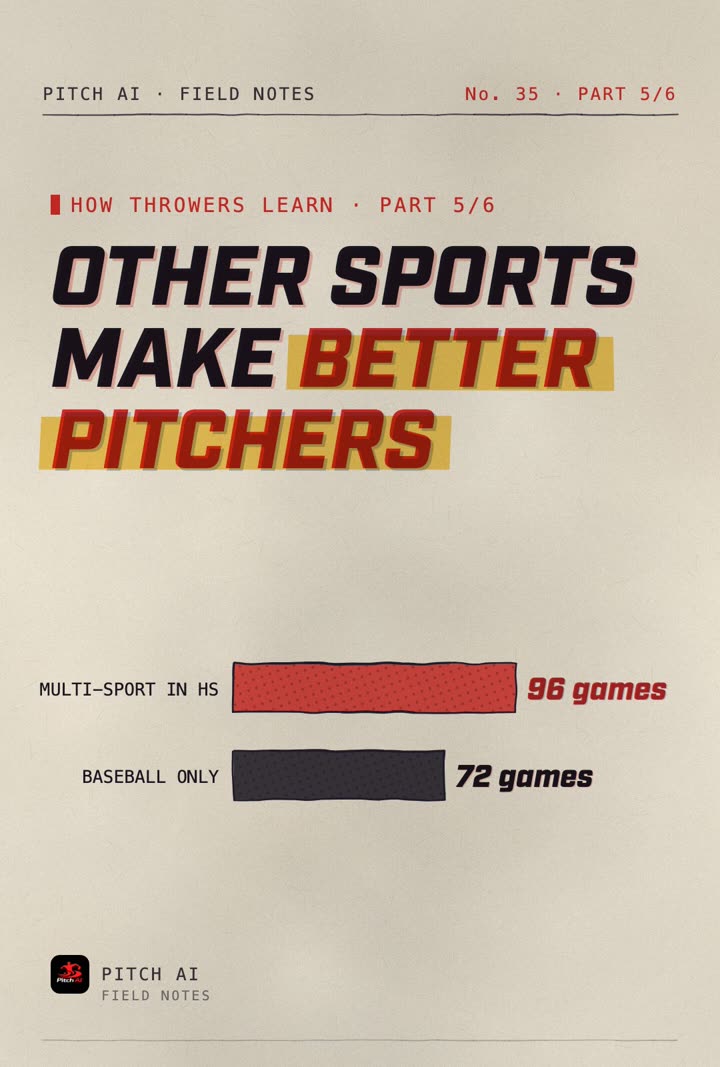
Confino and colleagues looked up public records for 746 first- and second-round MLB draft picks from 2008 to 2016 [1]. Of these, 240 had played more than one sport in high school and 506 had played only baseball. The multi-sport group played more total professional games (362.8 against 300.8 on average) and more MLB games (95.9 against 71.6).
They also had fewer arm problems. Among the players who reached the majors, upper-extremity injuries were recorded for 63% of the single-sport group against 50% of the multi-sport group. Among pitchers, the single-sport group had more shoulder and elbow injuries and more repeat elbow injuries (33% against 17% recurrence).
It is descriptive epidemiology from public records. Athletes who play several sports may be different in other ways, such as being more athletic or less worn down by year-round travel ball, and some players may have been misclassified. It shows an association, not that football or basketball caused the extra games.
Do single-sport pitchers throw harder in high school?
If specializing early buys a performance edge, it should show up in high school. Camp and colleagues followed 115 high school pitchers from several regions of the United States through a season [2]. About 53% played only baseball and 47% played other sports. There were no differences in pitch velocity, strength or range of motion between the groups, and no difference in how much they pitched. Past injury was reported by 38% of the specialists and 26% of the multi-sport athletes, a gap that was not statistically significant in a sample this size. The authors concluded that specializing gave these pitchers no competitive advantage on the measures they studied.
Why champions sampled more sports as kids
The biggest piece of evidence comes from outside baseball. Güllich, Macnamara and Hambrick pooled 51 study reports covering 6,096 athletes, including 772 of the world's top performers [3]. World-class adults had done more practice in other sports as children and teenagers, started their main sport later, accumulated less practice in it, and improved more slowly at first than national-level athletes.
The same paper explains why the specialization story feels true. Among youth athletes, the higher performers were the ones who started earlier and practiced their main sport more. Early focus wins junior competitions. The long-term picture reverses. For a pitcher, that means a 13-year-old who only plays baseball may well be ahead of his teammates, and that lead tells you little about who will be throwing at 22.
One plan, every season
Keep your pitching plan around your other sports
Pitch AI builds strength, workload and velocity work into one plan around your season, so a basketball winter or a football fall does not mean starting from zero in spring.


Why other sports might help a pitcher learn
The data tell us what happened. They do not tell us why. Brice Crider offers one explanation from a coach's point of view [4]. He observes that the best problem solvers he has met seem to keep creating problems for themselves, almost as a way of training the ability to solve them. A new sport, a new game or a heavier load is a problem. Solving many different kinds may build a general ability to learn movement quickly, which then helps with the specific problems of pitching.
The classic periodization literature makes a similar argument from the training side. Bompa and Haff describe multilateral development, broad work on strength, speed, endurance, flexibility and coordination, as the foundation in an athlete's early years, with the share of sport-specific training rising as the athlete matures [5]. Rob Gray argues that athletes trained with variety from early on become adaptable, able to find a new solution when conditions change, instead of relying on one rehearsed motion [6].
General training sets the floor, skill sets the ceiling
Crider frames general training this way. Building capacity and general coordination sets the floor of what an athlete can do, and developing the specific skill defines the ceiling [4]. He suggests three questions for judging whether an athlete is ready for the problems of their sport.
- Does the athlete have the strength, power and range of motion that elite performers in the sport show?
- Does the athlete have the general coordination and spatial awareness to keep progressing in skill work?
- Is the athlete durable enough to practice the specific skill with enough volume, intensity and frequency to improve?
Other sports can feed the first two. The third question is a reminder that the skill still needs a lot of practice. A multi-sport pitcher still has to throw, build a throwing base on a plan, and pitch enough to get good at pitching.
He also warns about difficulty. A problem far beyond the athlete's current ability produces failure without adaptation, and a problem that is too easy produces no adaptation at all. That is the same sweet spot we describe in random vs blocked practice.
Pickup play is not the magic part
One finding surprises people. In the Güllich meta-analysis, youth-led play, such as pickup games, had negligible effects on youth or adult performance [3]. What separated the world-class group was coach-led practice in other sports. That does not make pickup games bad. It means the benefit seems to come from real, organized challenge in a different sport, not just from running around.
Crider also describes elite athletes opening warm-ups with quick coordination games such as spikeball or a basketball shootaround [4]. We found no study testing whether that improves pitching, so treat it as a coaching idea. It is cheap, fun and unlikely to hurt.
How to fit another sport into a pitcher's year
Playing another sport works best as part of a plan, not as a break from planning. A few practical guidelines, based on the research above and on common coaching practice.
- Play the second sport in its own season: basketball in winter or football in fall, with real practices and games.
- Use it for your time off from throwing: MLB and USA Baseball's Pitch Smart recommends at least 4 months a year off from throwing for pitchers 14 and under, and for ages 15 to 18 at least 4 months off from competitive pitching with 2 to 3 continuous months away from overhead throwing [7]. Treat that as the floor.
- Mind other overhead loads: volleyball, tennis or playing quarterback still stress the throwing arm, so count them when you plan.
- Keep a strength thread running: two short lifting sessions a week during the other season protect what you built.
- Rebuild throwing gradually: when baseball returns, ramp volume and intent over several weeks. Our guide to progressing a throwing program lays out the steps.
For older high school pitchers chasing college ball, the balance shifts toward baseball, but the second sport can still be a strength. It builds athleticism, keeps the arm fresh during the other season, and gives you the kind of new problems Crider talks about. Our overview of youth pitcher development covers the bigger picture, and bio-banding explains why early size and early success can mislead.
Common mistakes
- Treating a 12-year-old's lead over his teammates as proof that specializing works.
- Dropping a second sport only to fill the time with more showcase throwing.
- Ignoring the overhead load of another throwing or hitting sport.
- Coming back from the other season and throwing at full intensity in week one.
- Reading observational data as a guarantee in either direction.
Frequently asked questions
Do multi-sport athletes do better in pro baseball?
In a study of 746 first- and second-round MLB draft picks from 2008 to 2016, players who played more than one sport in high school averaged 95.9 MLB games against 71.6 for baseball-only players, and had fewer upper-extremity injuries. The data are observational, so they show an association, not proof that the second sport caused it [1].
Does specializing in baseball make high school pitchers throw harder?
Not in the research so far. A study of 115 high school pitchers found no differences in pitch velocity, strength or range of motion between single-sport and multi-sport athletes [2].
At what age should a pitcher specialize?
There is no exact age. A large meta-analysis found that world-class adults started their main sport later and did more varied sport practice when young, even though early specializers often do better as juniors. Many coaches favor sampling sports through the early teens and gradually increasing baseball after that [3].
Is pickup play as good as organized sports?
Not according to the best available data. In the Güllich meta-analysis, youth-led play such as pickup games had negligible effects on youth or adult performance, while coach-led practice in other sports was linked with world-class outcomes [3].
Build the floor and the ceiling
One plan around every season
Pitch AI builds strength, workload and velocity work into one plan around your season, and ramps your throwing back up when baseball returns.
This article is part 5 of our How Throwers Learn series. Part 1 asks whether pitchers should practice skills when tired, part 2 covers how much to adjust after a missed pitch, part 3 asks whether practice can overfit like an AI model, part 4 explains why pitchers throw footballs and javelins, and part 6 covers how to handle failure while learning.
References
- Confino J, Irvine JN, O'Connor M, Ahmad CS, Lynch TS (2019). Early sports specialization is associated with upper extremity injuries in throwers and fewer games played in Major League Baseball. Orthopaedic Journal of Sports Medicine, 7(7), 2325967119861101. https://doi.org/10.1177/2325967119861101
- Camp CL, Erickson BJ, Bowman EN, et al. (2023). Early single sport specialization does not improve pitching velocity, motion, strength, or utilization in high school baseball pitchers. JSES Reviews, Reports, and Techniques, 3(4), 506-510. https://doi.org/10.1016/j.xrrt.2023.04.008
- Güllich A, Macnamara BN, Hambrick DZ (2022). What makes a champion? Early multidisciplinary practice, not early specialization, predicts world-class performance. Perspectives on Psychological Science, 17(1), 6-29. https://doi.org/10.1177/1745691620974772
- Crider B. The best problem solvers are also the best problem creators. bricecrider.com, September 8. bricecrider.com/blog/the-best-problem-solvers-are-also-the-best-problem-creators
- Bompa TO, Haff GG (2009). Periodization: Theory and Methodology of Training, 5th ed. Human Kinetics. Chapter 2, multilateral development versus specialization.
- Gray R (2021). How We Learn to Move: A Revolution in the Way We Coach and Practice Sports Skills. Perception Action Consulting and Education.
- MLB and USA Baseball. Pitch Smart pitching guidelines. https://www.mlb.com/pitch-smart/pitching-guidelines