
Pitchers can learn three things from how wrestlers move. Mobility only helps when a strong lower half supports it. The best athletes switch from full tension to full relaxation in an instant. And moving well comes from solving new movement problems, not repeating one pattern for years. Coach Clayton Thompson came back from three days training with wrestlers convinced that baseball players should borrow all three [1]. This article explains what he saw, what the research on multisport athletes and "donor sports" does and does not show, and how to add a little wrestling-style movement to a pitcher's week safely.
Why a pitching coach went to train with wrestlers
Thompson found wrestling coach Carolyn Wester on social media and could not stop watching. Her athletes were doing spinal extension drills, acrobatics and ranges of motion he had only associated with gymnasts, including backbend walks and even backbend runs across the mat [1]. So he booked a trip to Las Vegas and spent three days training at the Aniciete Training Club during the Wrestling US Open.
It humbled him. At 6 foot 6 and 235 pounds, he struggled with backflips and front handsprings while his training partner flipped around the gym even when exhausted. He watched a 270-pound wrestler land front handsprings as if he weighed 150 [1]. He also left with a sharper picture of movement than, in his words, any baseball convention had given him.
Mobility needs a strong base underneath it
The first lesson came from Wester's coaching. She describes the lower body as the car jack. It lifts and supports the upper body so the spine can rotate, bend sideways and extend [1]. Without that base, Thompson writes, you do not get meaningful extension or athletic rotation, and mobility without support just leaks energy.
The drills made it concrete. The L-stance, a wide staggered stance with a flat back, lit up his hamstrings and loaded his legs like a spring. In the over-under drill, which he calls the crown jewel for pitchers, the hips drive the torso into position while the head stays still and the shoulder blade pinches toward the spine. The trail-leg shot pushed his hips into a deep split. What separated his partner was not a deeper bridge but his ability to raise his hips, which gave the lower body room to move freely and made the trunk, arm and head work easier [1].
For pitchers this matches a common coaching theme. Many athletes chase spinal mobility, more arch and more rotation, without the lower-body strength and position to support it. This is a coaching observation rather than a tested finding, but it is a reasonable reminder that mobility work and strength work belong together.
Tense, then let go, in an instant
The second lesson was about relaxation. Thompson calls the ability to switch from tension to relaxation instantly the elite separator [1]. His partner would explode into a rotation, relax at once, and tense up again on landing. Wester linked moves like a forward roll into a backflip to train that snap.
Sprint coach Charlie Francis described the same thing decades ago. He saw raised, tense shoulders as the clearest sign of unwanted tension and noted that when the shoulders lock up, the hips stop moving freely too [2]. A pitcher who carries tension through the whole delivery may be fighting himself in the same way.
Be clear about the evidence. We could not find a study measuring how fast pitchers switch between tension and relaxation, or showing that training it adds velocity. It is a coach's observation shared by coaches from different sports.
One plan, every quality
Fit movement work into the whole week
Pitch AI builds strength, workload and velocity work into one plan around your season, so extra movement work has a place without crowding out throwing.


What is a donor sport for pitchers?
The third lesson is to keep solving new movement problems. Thompson argues that repeating the same patterns for years is not what makes an athlete elite, and that doing these kinds of movements a couple of times a week forces the body and brain to keep adapting [1].
Motor learning researcher Rob Gray calls this kind of activity a donor sport [3]. A donor sport shares some movements and opportunities for action with your main sport, but its open, exploratory nature makes you solve problems in new ways. His example is parkour for young soccer players, since weaving around obstacles shares skills with dodging a defender. Gray is careful to say these ideas still need to be tested in research. He also describes a 2015 study of 100 elite athletes in which body-position sense was higher in athletes than non-athletes, and it was not linked to years of sport-specific training [3]. That hints that broad movement experience, not more of the same sport, may build some of that awareness.
Classic training theory points the same way. Bompa and Haff argue that a broad base of general, multilateral development should come before heavy specialization, and that it supports higher performance later [5]. Our article on youth pitcher development covers what that looks like by age.
Do multisport athletes do better in pro baseball?
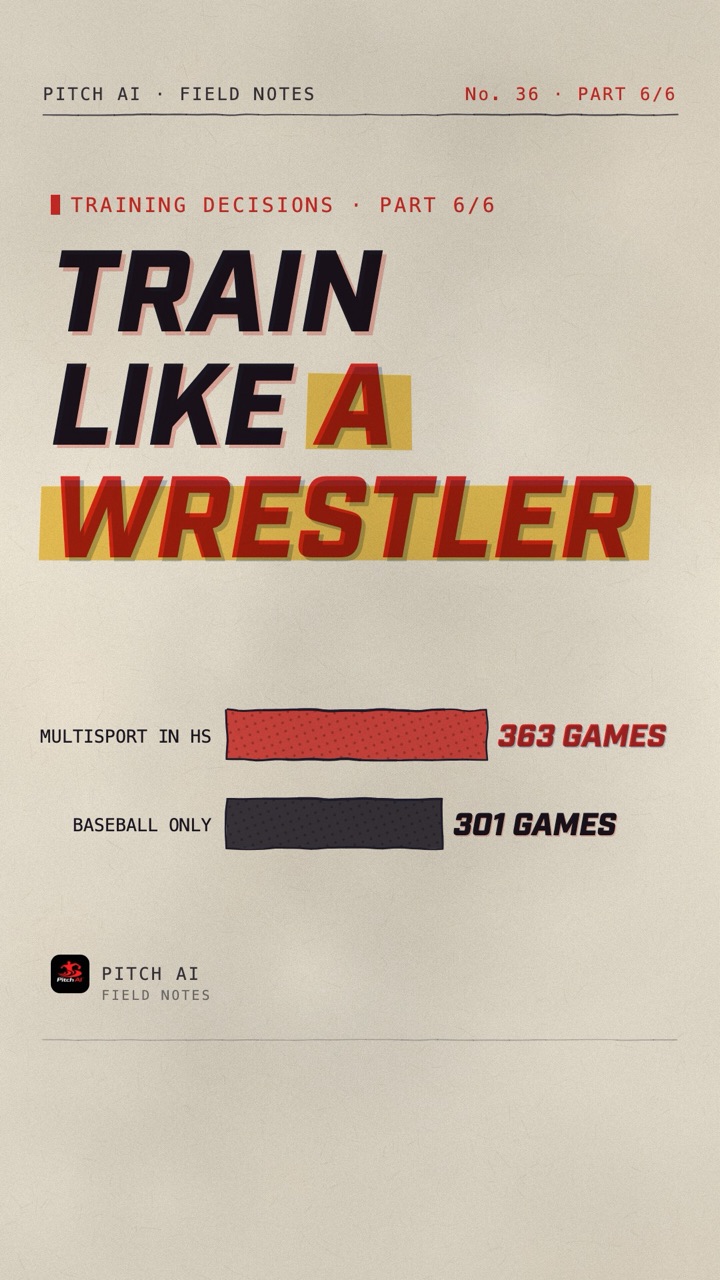
There is one useful data set. Confino and colleagues looked at 746 first- and second-round MLB draft picks from 2008 to 2016. Players who played more than one sport in high school averaged more total professional games (362.8 versus 300.8). Pitchers who played only baseball had more shoulder and elbow injuries and were about twice as likely to have a repeat elbow injury, 33 percent versus 17 percent [4].
This is an association. Athletes good enough to play several sports may simply be better athletes to begin with, and the study cannot separate that from any benefit of the other sports. It says nothing about wrestling drills in particular. It does fit the broader picture that early, narrow specialization is not the only route to the top.
How pitchers can add wrestling-style movement
You do not need to join a wrestling team. Thompson's suggestion is simply a couple of sessions a week of movements you have not mastered [1]. Here is a sensible way to start, ordered from easiest to hardest. Keep each session short, around 15 to 20 minutes, and put it on lower-intensity days or in a longer warm-up rather than right before your hardest throwing.
| Level | Movements | What it trains |
|---|---|---|
| Start here | Crawling patterns, L-stance holds, glute bridges, forward and backward rolls | Lower-half position, control on the ground |
| Build | Sprawls, stance changes, shots to the knee, hip-up bridges | Fast level changes, hips driving the trunk |
| Advance | Rolls into jumps, wall walks toward a backbend, over-unders | Tension and release, spinal range under control |
| With a coach and a mat | Handsprings, backflips, backbend walks | Full problem solving, only with supervision |
Move up a level when the current one feels smooth, not when it merely feels hard. Back, neck or shoulder pain is a reason to stop and see a qualified clinician. Flips and handsprings should only be learned with a coach and a proper mat.
An honest limit
Thompson's trip is one coach's experience, and the most impressive athletes he saw had trained this way for years. Treat wrestling-style work as a way to build movement skill and keep training interesting, not as a velocity program. Throwing, strength and recovery still do the heavy lifting. If you want more on why varied practice helps skills hold up, see random vs blocked practice for pitchers and whether great pitchers repeat their mechanics.
Common mistakes
- Copying the highlight videos. Flips without coaching are a fast way to get hurt.
- Chasing range without strength. Pair new range with the lower-body strength to support it.
- Turning it into conditioning. The goal is skill and problem solving, not exhaustion.
- Stealing time from throwing. Keep it short so the main work still gets done.
This article is part 6 of our Training Decisions series. The other parts cover part 1 on how much risk a pitcher should take in training, part 2 on how many throws a velocity day needs, part 3 on whether old school training methods still work, part 4 on how to choose exercises that keep paying off, and part 5 on how college pitchers should train from fall to winter.
Frequently asked questions
Is wrestling good for baseball pitchers?
It can build lower-body strength, body control and movement skill, but no study has tested wrestling drills for pitching velocity. Treat it as a donor sport for athleticism, and learn advanced moves like flips only with a coach and a mat. [1, 3]
What is a donor sport?
Rob Gray describes a donor sport as an activity that shares some movements and opportunities for action with your main sport and makes you explore new ways to move. He notes the idea still needs to be tested in research. [3]
Do multisport athletes have fewer injuries in baseball?
In a study of 746 top MLB draft picks, pitchers who played only baseball in high school had more shoulder and elbow injuries and more repeat elbow injuries, 33 versus 17 percent. The study shows a link, not proof of cause. [4]
Why does relaxation matter for pitchers?
Coaches like Clayton Thompson and Charlie Francis see the ability to release tension quickly as a mark of elite movers, since tension that lingers, such as raised shoulders, can lock up the hips. It is a coaching observation rather than a tested finding. [1, 2]
Train the whole athlete
Build strength, workload and velocity together
Pitch AI builds strength, workload and velocity work into one plan around your season, so the base under your mobility keeps growing.
References
- Thompson C (2025). Wrestling Reflection: Vegas Beatdown. Medium (blog), April 26, 2025. https://medium.com/@cl4ytonthompson/wrestling-reflection-vegas-beatdown-a8bcdd778fca
- Francis C (1992). The Charlie Francis Training System. TBLI Publications. (Shoulder tension and hip action in sprinting.)
- Gray R (2021). How We Learn to Move: A Revolution in the Way We Coach and Practice Sports Skills. Perception Action Consulting and Education. (Chapter 11, donor sports.)
- Confino J, Irvine JN, O'Connor M, Ahmad CS, Lynch TS (2019). Early sports specialization is associated with upper extremity injuries in throwers and fewer games played in Major League Baseball. Orthopaedic Journal of Sports Medicine, 7(7), 2325967119861101. https://doi.org/10.1177/2325967119861101
- Bompa TO, Haff GG (2009). Periodization: Theory and Methodology of Training, 5th ed. Human Kinetics. (Multilateral development versus specialization.)