
Machine learning has a famous failure called overfitting. A model scores beautifully on the examples it was trained on and falls apart on anything new. Motor learning researchers have their own name for a similar effect, the specificity of practice. Skills tend to become tuned to the exact conditions in which they were practiced. For a pitcher, that can mean a nasty bullpen and an ordinary game.
This article uses the AI comparison as a lens, explains the research behind specificity of practice and its limits, shows how growth spurts make a skill drift, and gives a simple weekly test that tells you whether your practice is transferring.
What overfitting means in plain words
Adam Bloebaum, who writes about the overlap between machine learning and human learning, describes overfitting as memorizing instead of generalizing [1]. A model is judged on data it has never seen before, and that test reveals whether it actually learned or just stored its training examples. Engineers fight overfitting with regularization, which means constraints that force the model to find general patterns.
The pitching translation is direct. Your bullpens, your home mound and your usual catcher are the training set. Games, new mounds, cold nights and hitters in the box are the test set. Bloebaum's piece is an analogy, and brains are not literally computers. The analogy is still useful because it gives you a vocabulary for a problem coaches have seen forever.
What the specificity of practice research shows
The classic study comes from Luc Proteau and colleagues in 1987 [2]. People practiced an aiming movement either with full vision of their arm and target or without it, for either 200 or 2,000 trials. Then everyone was tested without vision. The people who practiced with vision for 2,000 trials were more disrupted when vision was taken away than people who practiced with vision for only 200. More practice in one setting made them more dependent on that setting, which is close to what an engineer would call overfitting.
Later studies do not always reproduce the finding that reliance on one source of information grows with practice. The broad idea that skills carry the fingerprints of their practice conditions is well accepted. The exact size of the effect, and how it applies to a full-body throw, is less settled.
The five o'clock hitter problem
Baseball has a name for an overfit athlete. The five o'clock hitter crushes batting practice and disappears at seven. Brice Crider of Rubicon Performance uses exactly that example, borrowing a rule from the engineer Richard Hamming, who argued that the more tightly a system is tuned to its specifications, the worse it performs when overloaded [3]. When practice is too clean, Crider argues, the athlete is fitting the model to the training data.
Pitchers have their own version. Strikes in the bullpen, walks in the game. We cover that gap in detail in why pitchers throw strikes in the bullpen but not in games, and how to close it in how to make bullpens more like real games. This article adds a different question. How do you know if it is happening to you, before the season tells you?
Deep habits are hard to retrain
Overfitting has a second cost. Patterns grooved in one setting become stable, and stable patterns resist change. The Soviet-era throws coach Anatoliy Bondarchuk gives a memorable example from the hammer throw [4]. High-level athletes who came from the shot put, discus or javelin were harder to teach than beginners, because their learned order of using legs and arms was very stable. He wrote that unlearning it could take several years, while beginners learned the hammer pattern in months.
Crider describes good skill as a valley with a wide mouth, where many different starting conditions still flow toward a good outcome. A narrow, deep groove is reliable only when everything is exactly as it was in practice.
Measure the test set
See if your pitches hold up outside the pen
Pitch AI's Pitch Lab logs velo, IVB, spin, axis and release for every pitch, so you can compare the pitch you throw in practice with the one you throw somewhere new.


Your model drifts when your body changes
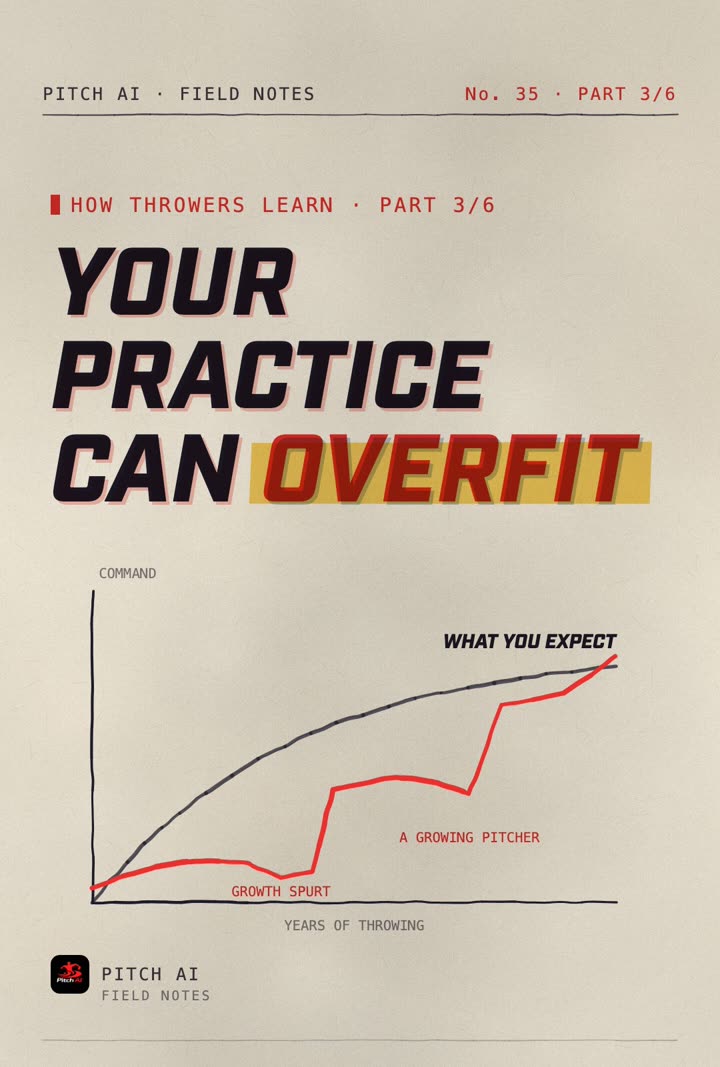
Bloebaum makes one more comparison that matters for young pitchers. Models in the real world drift [1]. The world they were built for keeps changing, and a model that is never retrained slowly stops being useful. A teenage body is a world that changes fast.
The NSCA's textbook notes that peak height velocity, the period of fastest growth, usually comes around age 12 in girls and 14 in boys, along with shifts in the center of mass [5]. A systematic review by Quatman-Yates and colleagues looked at 33 studies of sensorimotor function in adolescence and found signs that development continues through the teen years, with some adolescents showing temporary setbacks, the so-called adolescent awkwardness. The authors called the evidence limited [6]. Rob Gray describes our sense of what our body can do as a calibration that never stops, because growth, training, fatigue and injury keep changing what we can do [7].
The practical message for parents and young pitchers is not to panic when command slips during a growth year. The skill has not been lost. It was built for a body that no longer exists and has to be retrained, which is a normal part of youth pitcher development.
How to keep a test set
An AI engineer never grades a model only on its training data. A pitcher can borrow the habit with almost no extra work.
- Pick something new each week: a different mound, a new catcher, a hitter standing in, game counts called at random, or throwing after a short sprint to raise your heart rate.
- Keep it short: ten pitches is enough. The goal is to measure, not to train.
- Log the same numbers: strike rate and miss direction, plus pitch shape if you can measure it.
- Compare with practice: if the test set is far behind the bullpen, your practice is too narrow.
- Retest after changes: a growth spurt, a few weeks off or a new pitch all deserve a fresh test.
| Training set | A test set version |
|---|---|
| Home bullpen mound | A different mound or a flat-ground setup at a new distance |
| Same catcher every day | A new catcher or a different target |
| Pitch type known in advance | Catcher calls pitch and location at random |
| Fresh and relaxed | Game counts, a hitter in the box, light consequences |
Regularization for pitchers
If overfitting comes from practice that is too narrow, the cure is controlled variety. That is what most of the modern practice research recommends. Mixing pitch types and locations is covered in random vs blocked practice. Adding deliberate variation to the movement itself is the idea behind differential learning. Keeping the information from a real hitter in your practice is the point of perception-action coupling. Each one is a form of regularization. It makes practice slightly messier so the skill learns the general job.
This does not mean bullpens are useless. Specificity cuts both ways. Practice that is too far from the game does not transfer either. The goal is practice that looks like the game in the ways that matter, and varies in the ways the game varies.
Common mistakes
- Judging progress only by bullpen results on your home mound.
- Throwing every pen to the same catcher with the pitch called in advance.
- Treating a slump in a growth year as lost talent instead of a recalibration.
- Coming back from a break and expecting the skill to be exactly where you left it.
- Swinging to the other extreme with drills so random they look nothing like pitching.
Frequently asked questions
What is the specificity of practice hypothesis?
It is the idea that a skill becomes tuned to the information and conditions available during practice. In a classic aiming study by Proteau and colleagues, people who practiced 2,000 trials with full vision were more disrupted when vision was removed than people who practiced 200 trials. Later studies do not always find this [2].
What does overfitting mean for a pitcher?
An overfit pitcher is very good in the setting he practices in, such as one bullpen mound with one catcher, and noticeably worse anywhere else. The skill learned the details of practice instead of the general job of throwing strikes under changing conditions [1, 3].
Do growth spurts affect pitching command?
They can. Boys grow fastest around age 14 and girls around age 12, and a review of sensorimotor research found that some adolescents show temporary setbacks in coordination, though the evidence is limited. Expect to retrain command after a big growth period [5, 6].
How can a pitcher tell if practice transfers to games?
Keep a test set. Each week, throw a short set in a setting you did not practice in, such as a new mound, a new catcher or game counts, and log the results. If the test set lags far behind practice, the practice is too narrow.
Keep your own test set
Track the pitch, not just the pen
Pitch AI's Pitch Lab logs velo, IVB, spin, axis and release for every pitch. Log your weekly test set next to your bullpens and you will see drift before it shows up in a game.
This article is part 3 of our How Throwers Learn series. Part 1 asks whether pitchers should practice skills when tired, part 2 covers how much to adjust after a missed pitch, part 4 explains why pitchers throw footballs and javelins, part 5 looks at whether pitchers should play other sports, and part 6 covers how to handle failure while learning.
References
- Bloebaum A (2025). Thinking Alike. adambloebaum.com, October 10, 2025. adambloebaum.com/blog/thinking-alike/
- Proteau L, Marteniuk RG, Girouard Y, Dugas C (1987). On the type of information used to control and learn an aiming movement after moderate and extensive training. Human Movement Science, 6(2), 181-199. https://doi.org/10.1016/0167-9457(87)90011-X
- Crider B (2026). Skill Adaptation. Rubicon Performance, July 25, 2026. rubicon-performance.com/education/articles/skill-adaptation/
- Bondarchuk AP (2007). Transfer of Training in Sports. Ultimate Athlete Concepts.
- Haff GG, Triplett NT, eds. (2016). Essentials of Strength Training and Conditioning, 4th ed. NSCA, Human Kinetics. Youth chapter.
- Quatman-Yates CC, Quatman CE, Meszaros AJ, Paterno MV, Hewett TE (2012). A systematic review of sensorimotor function during adolescence: a developmental stage of increased motor awkwardness? British Journal of Sports Medicine, 46(9), 649-655. https://doi.org/10.1136/bjsm.2010.079616
- Gray R (2021). How We Learn to Move: A Revolution in the Way We Coach and Practice Sports Skills. Perception Action Consulting and Education.