
You miss high, so you aim lower. You miss low, so you aim higher. It feels like good coaching, and it is one of the most reliable ways to throw fewer strikes. Adjusting after a missed pitch is not wrong in itself. The problem is adjusting too much and too often, and treating every miss as a message when many of them are just noise.
This article explains the math behind overcorrecting in plain words, what lab research says about how much the nervous system corrects on its own, and a simple decision rule a pitcher can use in bullpens and games.
Why fixing every miss makes you wilder
The clearest demonstration comes from outside sport. The quality expert W. Edwards Deming used a funnel held over a target on a table [1]. Marbles dropped through the funnel land in a scatter around the target. Under the first rule, you leave the funnel alone. Under the second rule, after each drop you move the funnel by the opposite of the last miss. If the marble landed two inches left, you shift the funnel two inches right.
The second rule sounds smart. It doubles the variance of the scatter, which means the spread gets about 41% wider. The reason is simple. Each landing spot now contains two random errors, today's and yesterday's correction for yesterday's error, and random errors add up instead of cancelling out.
Deming's result assumes the misses are pure noise around a correct aim. A pitcher's misses are not always like that. If your release point has drifted, or the mound is different, part of each miss is real and worth correcting. That is why the answer is a partial correction, not zero correction.
How much does the brain correct after an error?
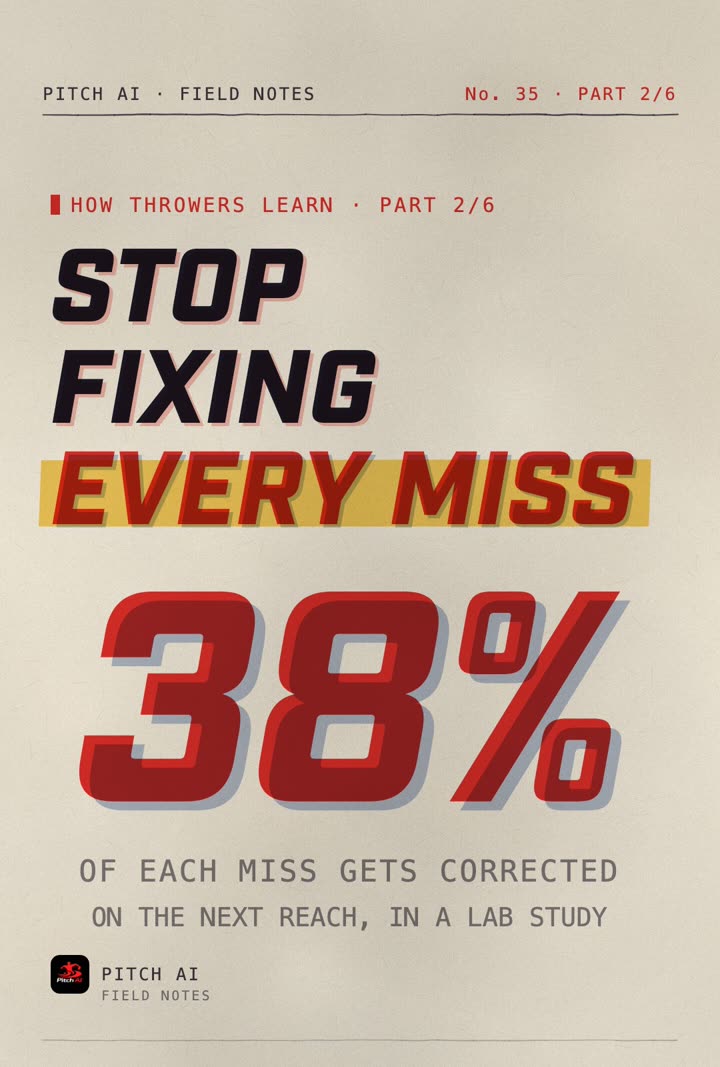
Robert van Beers studied this in people making ordinary reaching movements in a lab [2]. He estimated a learning rate of about 0.38, which means people corrected roughly 38% of each error when planning the next movement. Then he modeled what rate would keep the scatter smallest, given that movements contain both random execution noise and slow drift in the plan. The best rate came out at about 0.40, statistically the same as what people actually did. A larger rate made the average error bigger than it needed to be.
The shape behind that finding is a U. Correct too little and slow drift goes unchecked. Correct too much and you chase noise. The bottom of the U sits somewhere in between.
Two cautions. The 38% comes from reaching, not pitching, and van Beers notes that the right rate can be different in other tasks. And nobody is asking you to calculate percentages on the mound. The practical lesson is that a good adjustment is a nudge, not a full swing in the other direction.
Motor learning is error correction
Adam Bloebaum, who writes about motor learning from an engineering and data background, describes skill learning as an optimization loop [3]. You make an attempt, measure the error, nudge the plan in the direction that would have reduced it, and try again. The size of the nudge is the learning rate. In his framing it is high early, when big changes are useful, and shrinks as you get close to a good solution so you stop overshooting.
Bloebaum also explains why beginners overcorrect. Early on, the brain has no reliable prediction of how a throw will turn out, so it leans hard on what it just saw. In engineering terms the feedback gain is high, and every error triggers an aggressive response. With experience the internal model improves, the brain trusts its prediction more, and a single strange result moves it less. He uses the Kalman filter, a standard tool for blending a prediction with a noisy measurement, as the model for that shift.
This connects to a much older observation. Rob Gray describes Bernstein's blacksmith, who hit the same spot over and over without repeating the same movement [5]. Skilled movers repeat the outcome, not the motion. That is a reason not to panic about a pitch that felt different. Some variation in how it felt is normal, and it only matters if the outcome pattern changes. Our article on whether great pitchers repeat their mechanics goes deeper into that idea.
Practice command on purpose
Give command its own day
Pitch AI builds dedicated Command days into your throwing program, so you have planned sessions to work on misses instead of chasing them in games.


Noise or a real miss? A decision rule
Here is a practical rule set built on that research. These are coaching rules of thumb, not tested protocols, and the thresholds are deliberately simple so a pitcher can use them without a chart.
| What you see | What it probably is | What to do |
|---|---|---|
| One miss in any direction | Noise | Nothing. Same target, same delivery. |
| Same miss on 3 of the last 5 pitches | A small real bias | Move the aim point a little, roughly a third of the miss. |
| The same miss for a whole outing | A bigger bias, maybe fatigue, mound or release drift | Keep the small aim shift in the game. Take the problem to practice. |
| The same miss across several sessions | A pattern in the delivery or the plan | Work on it in practice with a constraint or drill, and film it. |
The "roughly a third" figure borrows the spirit of the 38% finding. It is a reminder to under-correct, not a number to measure.
Adjust the aim, not the delivery
An aim point is one simple knob. A delivery has dozens of moving parts, and changing one of them often changes others you did not intend. That is why a mid-game mechanical fix after two walks so often makes things worse, a problem we cover in why fixing one mechanical flaw does not fix your pitching.
Boddy and Daniels make a related point in Hacking the Kinetic Chain. They write that athletes learn best when they can internalize movement patterns without being told exactly what to do, and that more than a little verbal instruction during drill work is largely ineffective [6]. Shifting the target lets the body reorganize on its own. Shouting "stay closed" asks the thinking brain to run a movement it is too slow to control.
When a miss pattern does persist across sessions, practice is the place to address it. One differential command program built for Driveline's command training balls uses heavier or larger balls when misses cluster high and to the arm side, and lighter or smaller balls when they cluster low and to the glove side [4]. That is a practitioner program, not a tested trial, but it shows the idea of changing the task instead of lecturing the delivery. For more on that approach, see how to use task constraints to improve command.
How to track your misses
You cannot tell noise from a pattern without a record. After each bullpen, note roughly how far and in which direction your misses went for each pitch type. Up or down, arm side or glove side, and whether the misses were bunched or spread. Over a few weeks, the pattern tells you whether you have a real bias or a normal spread. It also stops one bad day from feeling like a crisis.
A sample command bullpen
- Set 1, 10 fastballs: one fixed target. Do not change anything after single misses. Just note where they go.
- Set 2, 10 fastballs: apply the rule. If 3 of the last 5 missed the same way, shift the aim slightly and keep the delivery.
- Set 3, 12 mixed pitches: catcher calls pitch and location at random, as in random practice.
- After: log miss direction and distance by pitch type, and compare with last week.
Common mistakes
- Correcting the full size of every miss, which widens the scatter.
- Changing the delivery in a game after one or two bad pitches.
- Judging command from the last pitch instead of the last ten.
- Never correcting at all when the same miss shows up all day.
- Not writing anything down, so every session starts from memory.
Frequently asked questions
Should a pitcher change something after every missed pitch?
No. If misses are mostly random, fully correcting after each one makes the scatter wider. Deming's funnel experiment shows that this habit doubles the variance, which is about 41% more spread. Treat one miss as noise and act on a pattern [1].
How much do people naturally correct after an error?
In a lab reaching study, people corrected about 38% of each error on the next movement, which was almost exactly the rate that kept their scatter smallest. The right amount depends on the task, and it has not been measured in pitching [2].
Why do pitchers overcorrect?
Beginners lean heavily on the result of the last attempt because they do not yet have a good internal model of the movement. As skill grows, they rely more on prediction and less on each single outcome, so one strange miss moves them less [3].
Should I fix my mechanics when I miss in a game?
Usually not in the middle of an outing. A small change of aim point is a safer in-game adjustment. Mechanical changes are better explored in practice, where you can repeat them many times and measure the result.
Command is a skill
Train it on a plan
Pitch AI builds dedicated Command days into your throwing program, so the work on misses happens in practice, with enough reps to tell noise from a pattern.
This article is part 2 of our How Throwers Learn series. Part 1 asks whether pitchers should practice skills when tired, part 3 asks whether practice can overfit like an AI model, part 4 explains why pitchers throw footballs and javelins, part 5 looks at whether pitchers should play other sports, and part 6 covers how to handle failure while learning.
References
- Deming WE (1986). Out of the Crisis. MIT Center for Advanced Engineering Study. Pages 327-332, the funnel experiment.
- van Beers RJ (2009). Motor learning is optimally tuned to the properties of motor noise. Neuron, 63(3), 406-417. https://doi.org/10.1016/j.neuron.2009.06.025
- Bloebaum A (2026). Quantitative Motor Learning Principles. adambloebaum.com, February 17, 2026. adambloebaum.com/blog/quantitative-motor-learning/
- Differential Command Program, for use with Driveline Command Training Balls. Practitioner program notes, undated.
- Gray R (2021). How We Learn to Move: A Revolution in the Way We Coach and Practice Sports Skills. Perception Action Consulting and Education.
- Boddy K, Daniels M (2017). Hacking the Kinetic Chain: Advanced Pitching. Driveline Baseball.