
Watch a modern throwing session and you may see javelins, foam footballs, softballs, tiny command balls and heavy balls, all before the first baseball. To a parent it can look like a circus. The idea behind it is simple, and it is not new. Changing the thing you throw changes the problem your body has to solve, and the solutions you find can carry over to the pitch.
Brice Crider, a throwing coach who has worked with high-level pitchers in the United States and Japan, has written a clear framework for organizing these variations [1]. This article walks through his skill funnel and four buckets of variation, what biomechanics research says about each one, the safety questions, and a sample progression.
The skill funnel has a narrow goal and wide means
Crider's starting point is that athletic specialization is narrow in its goals but not in its means [1]. A pitcher's goal is tight. Throw a baseball hard and accurately from a mound. The number of ways to train toward that goal is huge. So instead of asking which drills make you throw harder, he suggests asking what currently limits your output, and which kinds of training would remove that limit.
This sits inside the constraints-led approach, which we explain in what the constraints-led approach is in pitching. That article covers the theory. This one is about the practical sorting problem. With nearly unlimited possible variations, a coach needs a few buckets to make decisions quickly.
Four ways to change a throw
Crider groups task constraints for throwers into four buckets, which can be blended [1].
| Bucket | What changes | Examples |
|---|---|---|
| 1. Weight | Mass of the implement | Heavy and light balls, plyo balls |
| 2. Size or shape | How the implement resists rotation (its moment of inertia) | Footballs, javelins, softballs, undersized command balls |
| 3. How the body starts | Position and speed of the center of mass relative to ground and target | Kneeling, flat ground vs mound, step-backs, drop steps, pulldowns |
| 4. Where the arm starts | Starting position of the arm and other limbs relative to the body | Pivot pick variations, preset arm positions, glove taps |
What changing the weight does
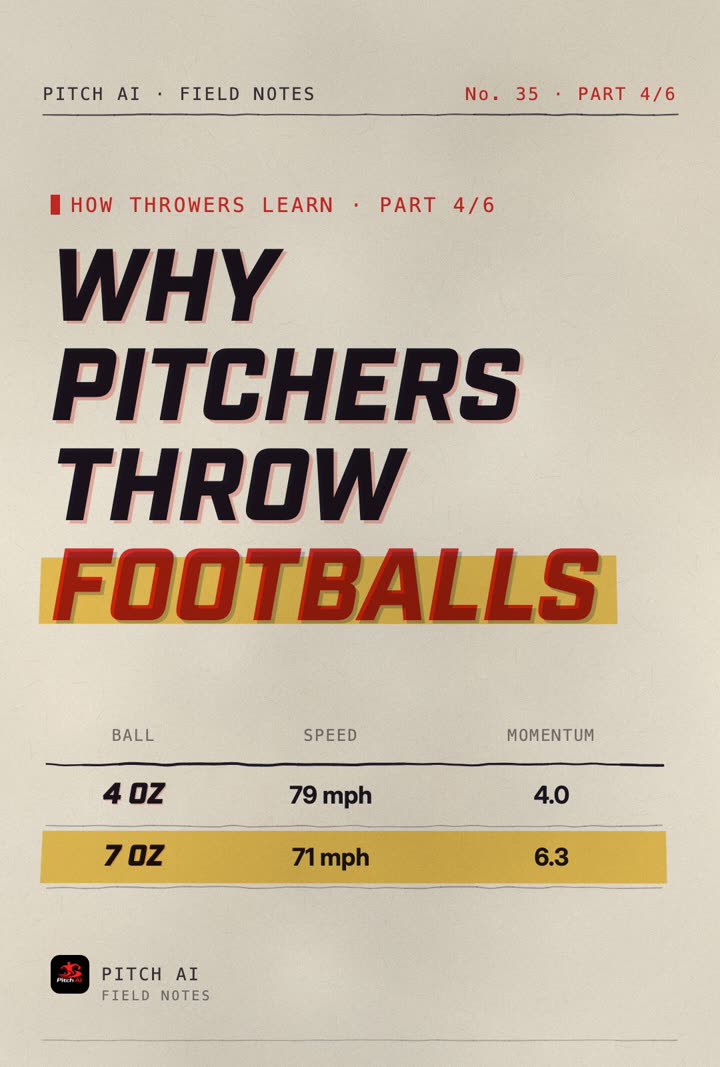
Weight is the most studied bucket. Glenn Fleisig and colleagues had 25 high school and college pitchers throw balls of different weights at max effort from a mound with motion capture [2]. A 4 ounce ball left the hand at 35.4 meters per second, about 79 mph. A 7 ounce ball left at 31.9 meters per second, about 71 mph. Shoulder rotation speed fell too, from about 6,579 to 6,111 degrees per second.
Slower does not mean easier for the body. Momentum is mass times speed, and when we work it out from the study's numbers, the 4 ounce ball carried about 4.0 units of momentum and the 7 ounce ball about 6.3, roughly 58% more. The arm has to give the heavy ball more total push, spread over a longer time.
Crider describes this in terms of force-time shapes. In his view, heavier implements bias more total force over a longer time with a lower peak, and lighter ones bias sharper, higher peaks [1]. He also argues that heavy implements teach the thrower to relax into good positions, while light ones expose sequencing flaws at high speed. Those are coaching observations. The Fleisig data show the speed and momentum side, not the full force curves.
In Fleisig's adult and college pitchers, heavier balls produced lower elbow torque from the mound (about 90 newton-meters with the 5 ounce ball and 79 with the 7 ounce) [2]. In a study of 19 youth pitchers aged 9 to 14 throwing on flat ground, each extra ounce raised elbow torque slightly [4]. Kids are not small adults. Our weighted ball training guide covers dose and progression in detail.
What changing the size or shape does
Shape changes the delivery even when the athlete is trying to do the same basic thing. Fleisig's group compared 26 quarterbacks and 26 pitchers at the high school and college level [3]. Pitchers reached larger and earlier peak rotation speeds of the pelvis, trunk and arm. Quarterbacks took shorter strides, stood more upright at release, and kept more elbow bend and horizontal adduction during arm cocking.
Crider's coaching logic goes further. A larger implement, like a football, makes the arm stay laid back longer. A smaller one makes the hand and forearm more of a driver. A long, linear javelin punishes any throw that drifts off the line toward the target, so the thrower has to learn to move the body along that line [1]. These are his interpretations, but they line up with a well-supported idea in motor learning. Rob Gray reviews research where scaled equipment changed how young athletes coordinated their movement, including lighter basketballs that improved shooting accuracy and confidence in 10-year-olds [5].
Ben Brewster of Tread Athletics makes a related point in Building the 95 MPH Body. Throwing a 5 ounce ball 60 feet is a baseball skill, but overhand throwing itself is general, so methods that help athletes throw a softball, a football, a handball or a javelin may have some value for pitchers too [6]. He is careful to add that the mechanics are not identical.
Track every throw
Log the variations, not just the pitches
Pitch AI logs every throwing session, intensity included, and builds your workload progressively, so new implements and drills add to your plan instead of sneaking extra stress into it.


Changing how the body and arm start
The last two buckets change the starting conditions instead of the implement. Throwing from a mound gives you a slope to fall down. Kneeling removes most of the lower body. A step-back, drop step or running start presets the body moving toward the target at a different speed [1]. Brewster notes that most athletes throw about 3 to 6 mph harder with a running start than from their pitching motion [6].
Faster is not free. In Fleisig's study, flat-ground crow-hop throws with a 5 ounce ball came out faster than mound throws (37.7 against 34.2 meters per second) and produced slightly more elbow torque [2]. Running throws belong in a plan as high-intensity work and should be counted as such.
Arm presets, like the many versions of the pivot pick, change where the arm begins relative to the body. That changes which movement patterns are easy to fall into once the throw starts. If you want ideas for these drills at home, our list of pitching drills with little space or gear includes several.
Always finish with a baseball
Crider stresses that every variation only means something relative to the competition implement [1]. A turbo javelin is a heavy, low-freedom implement for a baseball player and a light, high-freedom one for a javelin thrower. He describes watching a pitcher in Japan who threw about 95 mph run through a progression that moved step by step toward the baseball.
A sample progression for a high school pitcher
Here is a simple way to try the idea on a catch play day. It is an example, not a validated program, and it assumes a pitcher who already throws regularly without pain.
- Football, 8 to 10 throws: easy distance, spiral as the goal, effort around half.
- Softball or slightly heavier ball, 8 throws: smooth, long push, moderate effort.
- Small command ball, 8 throws: to a partner's chest, accuracy as the goal.
- Baseball, rest of catch play: normal routine, noticing what carried over.
Change one bucket at a time for a few weeks and see what happens to your baseball throws. If a variation makes something hurt, drop it and get checked by a qualified clinician. The added throws count toward your workload, so plan them, especially in season.
What the research cannot tell you yet
The studies here describe how mechanics change with the implement. None of them tested whether a season of football or javelin throws makes a pitcher better. Crider himself says the next step is to motion capture many versions of each bucket and connect them to specific skills [1]. Until then, the buckets are a coaching heuristic that helps you choose variations on purpose, and the baseball is the judge.
Common mistakes
- Adding several new implements at once, so you cannot tell what helped.
- Throwing heavy or running throws at max effort without counting them as hard throws.
- Ending a session on a football or javelin instead of baseballs.
- Copying a pro's warm-up without asking what limits your own throw.
- Using adult weighted-ball assumptions for a 10-year-old.
Frequently asked questions
Is throwing a football good for pitchers?
It can be a useful variation. A football changes the shape and weight of the implement, so the body has to organize the throw differently. Research comparing quarterbacks and pitchers found shorter strides, a more upright trunk and more elbow bend in football passing. Use it as a variation and always finish with baseballs [3].
Why do some pitchers throw javelins?
A javelin is long and linear, so it punishes a throw that pulls off the line toward the target. Coaches such as Brice Crider use it to challenge how the thrower moves the body and arm along the line of the throw. It is a coaching heuristic, not a tested velocity method [1].
Do heavier balls put more stress on the arm?
In adult and college pitchers throwing from a mound, heavier balls produced lower arm speed and lower elbow torque than a 5 ounce baseball. In a youth study, each extra ounce raised elbow torque slightly, so the answer depends on age. Any new implement should be introduced gradually [2, 4].
Has anyone proven these throwing variations work?
Not head to head. Studies describe how different implements change the mechanics, and research on scaled equipment in youth sports supports changing equipment for learning. No trial has compared footballs, javelins and other variations for pitching outcomes [5].
Variations on a plan
Build workload you can see
Pitch AI logs every throwing session, intensity included, and builds your workload progressively. Add a new implement as one change, and watch how it fits into your week.
This article is part 4 of our How Throwers Learn series. Part 1 asks whether pitchers should practice skills when tired, part 2 covers how much to adjust after a missed pitch, part 3 asks whether practice can overfit like an AI model, part 5 looks at whether pitchers should play other sports, and part 6 covers how to handle failure while learning.
References
- Crider B. Constraint Based Learning Heuristics for Throwers. bricecrider.com, January 10. bricecrider.com/blog/constraints-based-learning-heuristics-for-throwers
- Fleisig GS, Diffendaffer AZ, Aune KT, Ivey B, Laughlin WA (2017). Biomechanical analysis of weighted-ball exercises for baseball pitchers. Sports Health, 9(3), 210-215. https://doi.org/10.1177/1941738116679816
- Fleisig GS, Escamilla RF, Andrews JR, Matsuo T, Satterwhite Y, Barrentine SW (1996). Kinematic and kinetic comparison between baseball pitching and football passing. Journal of Applied Biomechanics, 12(2), 207-224. https://doi.org/10.1123/jab.12.2.207
- Okoroha KR, Meldau JE, Jildeh TR, Stephens JP, Moutzouros V, Makhni EC (2019). Impact of ball weight on medial elbow torque in youth baseball pitchers. Journal of Shoulder and Elbow Surgery, 28(8), 1484-1489. https://doi.org/10.1016/j.jse.2019.01.025
- Gray R (2021). How We Learn to Move: A Revolution in the Way We Coach and Practice Sports Skills. Perception Action Consulting and Education.
- Brewster B (2015). Building the 95 MPH Body. Tread Athletics. Chapter 2.