
Every pitcher fails a lot. Walks, hard contact, a new pitch that hangs, a velocity day that comes up short. Learning to handle failure as a pitcher is not about pretending it does not sting. It is about where the failure lands. If a bad outing lands on you, every miss becomes a judgment of your worth and practice gets tense. If it lands on the throw, a bad day is information about a skill that is still growing.
This last part of our series looks at a simple language habit elite throwers share, why tolerance for failure is built into how humans learn movement, what lab research says about self-distancing, and a practical routine for after a rough outing.
Why elite throwers say "my throw"
Brice Crider has worked with elite throwers and hitters in several countries, and he noticed something about how they talk [1]. They describe their throw as a thing they own and look after, not as an action. "My throw is in a good spot right now." "I need to find my throw again." That is almost the opposite of "I need to throw better."
Crider compares it to a gardener talking about a bonsai tree. The skill is something the athlete is responsible for caring for and developing, with its own ideal shape. When the tree has a bad week, the gardener does not decide he is a bad person. He asks what the tree needs.
Failure tolerance is built into learning
Crider argues that separating the skill from the self gives an athlete a built-in tolerance for failure [1]. His comparison is a parent watching a child learn to walk. Nobody calls a fall a failure, because falling is part of how walking is learned.
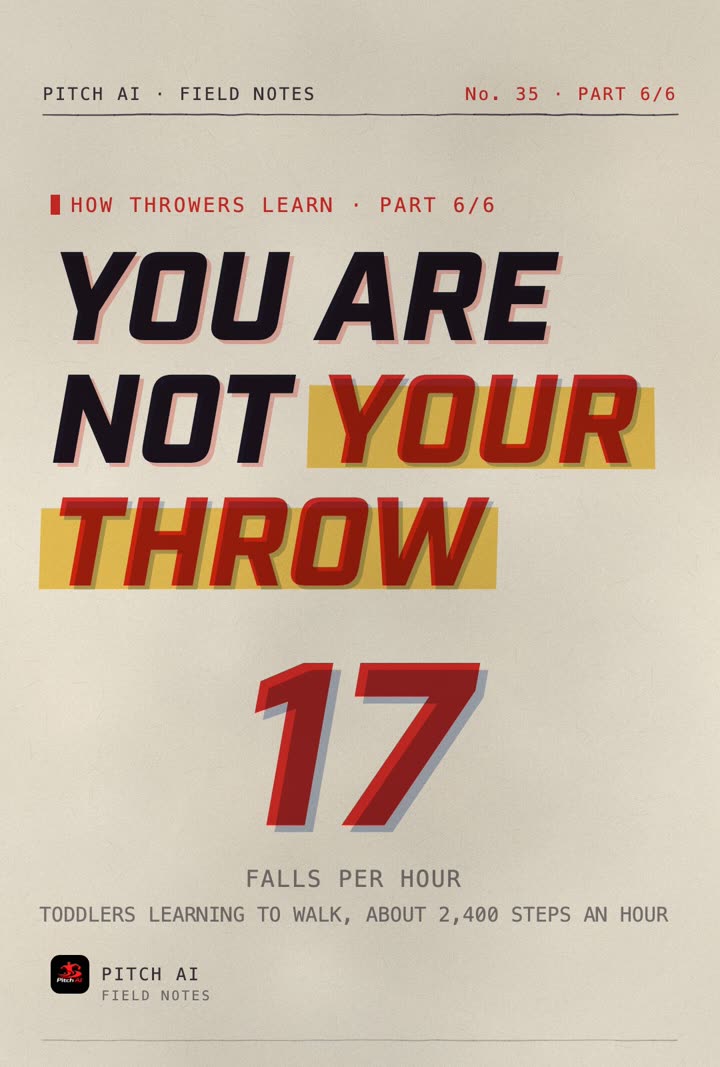
Research on infants shows how literally true that is. Karen Adolph and colleagues recorded toddlers during free play and found that children between 12 and 19 months averaged 2,368 steps and 17 falls per hour [2]. The authors describe huge amounts of spread-out, varied practice as the natural way humans learn to walk. Seventeen falls an hour is not a problem to fix. It is the process.
Rob Gray makes the coaching version of this point. Modern practice methods, like adding variability or constraints, work only if the athlete is willing to make mistakes in practice [5]. An athlete who feels scouted on every rep, and needs each one to be perfect, will respond poorly to anything that makes him fail more often. Gray's advice is to start such athletes with less variability. A pitcher who can separate the throw from the self can handle more of the productive struggle that learning requires.
That struggle often includes looking worse before looking better. We cover the dip in why pitchers get worse after changing their mechanics.
What self-distancing research shows
Is there evidence that stepping back from yourself helps under stress? The closest lab research comes from Ethan Kross and colleagues [3]. Across seven studies with 585 people, they compared self-talk that used "I" with self-talk that used the person's own name or "you." The non-first-person version increased psychological distance. In a first-impression task and a public-speaking task, those people performed better according to objective raters, and showed less distress. They also tended to see upcoming stressful events as challenges instead of threats.
Talking about "the throw" instead of "me" is a close cousin of that idea. It is not proven for pitching, but it costs nothing to try.
Watch the throw grow
See the trend, not just the last outing
Pitch AI logs every throwing session and tracks your velocity trend, so you can watch your throw grow over weeks instead of judging it by one bad day.


Quiet the judge and let the ball teach
Crider borrows a famous split from Tim Gallwey's The Inner Game of Tennis [4]. Gallwey describes Self 1 as the voice that instructs, worries and judges, and Self 2 as the part of you that actually performs the movement. Gallwey's book includes a passage about how we never criticize a rose seed for having no roots or stem. We simply give it what it needs at each stage. Crider uses the same image for a developing throw.
His practical conclusion is to keep the judging mind away from the skill and let feedback from the skill itself drive the adjustments [1]. For a pitcher that feedback is ball flight. Where did it go, how did it move, how hard was it. Boddy and Daniels make a related point about instruction. They write that athletes learn best when they can internalize movement patterns without being told exactly what to do [6]. A running commentary from the judge, inside your own head, is a kind of over-instruction too.
Grade outings by the throw, not by yourself
Here is a short routine for after a rough outing or bullpen. It takes five minutes and keeps the review about the skill.
| Judging the self | Tending the throw |
|---|---|
| I was terrible today. | The fastball missed arm side and up most of the night. |
| I can't throw a changeup. | The changeup is still too firm. It needs more reps at low intent. |
| I'm losing it. | Velocity was 2 mph under my recent trend after a short night of sleep. |
| I'll never be good enough. | The throw is six weeks into a change. Check the trend in a month. |
Give changes weeks, not days
A throw that is being rebuilt will have bad days, and a single game is a small sample. Judge a new grip, a delivery change or a velocity block by its trend over several weeks. If you track your sessions, you can see that trend instead of guessing it. Our article on how pitchers actually learn new skills explains why learning curves are bumpy, and why pitchers should measure velocity and track their lifts covers what to record.
The same patience applies to pressure. If games feel different from practice, the answer is usually more game-like practice, not more self-criticism. See how pitchers train to perform under pressure.
Could this be survivorship bias?
Crider is upfront that his observation may be survivorship bias [1]. We only hear from the throwers who made it. Maybe the ones who talked about "my throw" succeeded because of that mindset. Maybe they talked that way because they were already succeeding. Crider's own reading is that athletes who took slow development as a personal failure, as he says he once did, tended to quit before their throw could become what it might have been. That is a plausible story, not a measured one. The habit is still free, and the supporting research on learning and self-distancing points the same way.
When it is more than a bad day
Separating the skill from the self is for the normal ups and downs of learning. If you dread throwing, lose interest in the game, or feel anxious most days, talk to a parent, a coach you trust, or a sports psychologist. And if something hurts when you throw, that is not a mindset problem. Stop, and get it checked by a qualified clinician.
Common mistakes
- Grading an outing with words about yourself instead of facts about the ball.
- Changing the delivery after one bad game because it felt like a crisis.
- Expecting a new pitch to work in games within days.
- Avoiding hard practice so you do not have to fail in front of others.
- Using "it is just the throw" as an excuse to skip the work the throw needs.
Frequently asked questions
How do you get over a bad outing as a pitcher?
Grade the outing by what the ball did, not by what it says about you. Write down a few ball flight facts, pick one thing the throw needs, plan the next session around it, and let the rest go. Judge progress over weeks, not one game.
What does separating the skill from the self mean?
It means treating your throw as something you develop and care for, the way a gardener tends a plant, instead of as a verdict on who you are. Coach Brice Crider noticed that elite throwers often talk about their throw this way [1].
Does talking to yourself in the third person help?
In lab studies by Kross and colleagues, people who coached themselves using their own name or the word you, instead of I, showed less distress and performed better under social stress. Those tasks were speeches and first impressions, not sport, so treat it as a promising tool [3].
How long should I give a mechanical change before judging it?
Weeks, not days. New movement patterns often look worse before they look better, so judge a change by the trend across several sessions rather than one outing.
Tend your throw
Track the throw over time
Pitch AI logs every throwing session and tracks your velocity trend, so you can watch your throw grow and judge changes by weeks of data instead of one outing.
This article is part 6, the final part, of our How Throwers Learn series. Part 1 asks whether pitchers should practice skills when tired, part 2 covers how much to adjust after a missed pitch, part 3 asks whether practice can overfit like an AI model, part 4 explains why pitchers throw footballs and javelins, and part 5 looks at whether pitchers should play other sports.
References
- Crider B. Separating the Skill from the Self. bricecrider.com, October 9. bricecrider.com/blog/separating-the-skill-from-the-self
- Adolph KE, Cole WG, Komati M, Garciaguirre JS, Badaly D, Lingeman JM, Chan GL, Sotsky RB (2012). How do you learn to walk? Thousands of steps and dozens of falls per day. Psychological Science, 23(11), 1387-1394. https://doi.org/10.1177/0956797612446346
- Kross E, Bruehlman-Senecal E, Park J, et al. (2014). Self-talk as a regulatory mechanism: how you do it matters. Journal of Personality and Social Psychology, 106(2), 304-324. https://doi.org/10.1037/a0035173
- Gallwey WT (1974). The Inner Game of Tennis. Random House.
- Gray R (2021). How We Learn to Move: A Revolution in the Way We Coach and Practice Sports Skills. Perception Action Consulting and Education.
- Boddy K, Daniels M (2017). Hacking the Kinetic Chain: Advanced Pitching. Driveline Baseball.