
Practicing skills when fatigued is one of the most common habits in baseball. Pitchers lift, run and then try a new changeup grip at the end of practice because that is when there is time. The research on motor learning suggests that order is backwards. Fatigue does not only make today's reps worse. It can slow how fast you learn from them, and that cost can follow you into the next session.
This article covers what the main fatigue study found and its limits, why skill obeys the same stress and recovery rules as strength, how spacing between sessions changes learning, and a simple way to order a pitcher's day and week so new skills get the freshest minutes.
Does fatigue hurt learning or just performance?
Everyone knows a tired athlete performs worse. The harder question is whether practice done tired still teaches you as much once you recover. A team at Johns Hopkins led by Meret Branscheidt and Pablo Celnik tested this directly in 2019 [2].
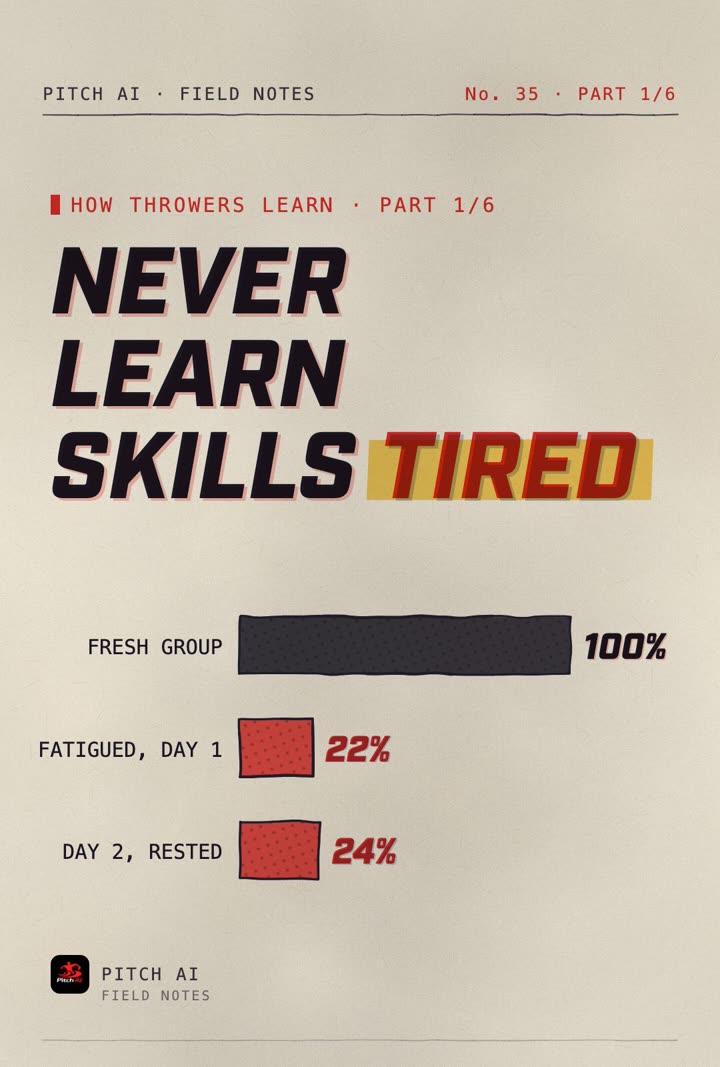
Adults learned a new skill that required controlling pinch force precisely to move a cursor. In the main experiment, 20 people first squeezed as hard as they could until their force dropped, which took about a minute, and 18 people did not. Both groups then practiced the skill. On day one the fatigued group's learning rate was 0.038 compared with 0.169 for the fresh group, which is about 22% of normal. On day two nobody was fatigued, yet the formerly tired group still learned at about 24% of the fresh group's rate (0.083 against 0.339). The authors wrote that the harmful effect lasted for almost two full extra training sessions.
Two details make the result more interesting. The fatigued people also learned less with their untrained hand, and brain stimulation over the motor cortex after day one removed the day-two deficit. That points to a change in the brain, not just a tired muscle.
This was a lab pinch-force task in healthy adults, not throwing. In the same paper, a finger-tapping sequence task was not affected by fatigue [2]. So the effect may depend on how much the skill relies on controlling force, which a pitch certainly does, but nobody has run this study with pitchers.
Why skill follows the same stress and recovery rules as strength
Brice Crider of Rubicon Performance argues that skill adapts by the same rules that build muscle [1]. A stimulus disrupts the system, you recover, and you settle at a slightly better level. His list of principles, which he takes from Israetel and colleagues, includes fatigue management and the stimulus, recovery and adaptation cycle. If that framing is right, fatigue is not just an inconvenience for skill work. It is a variable you have to plan, exactly like you plan the gap between two heavy squat days.
Rob Gray makes a related point from the perception side. Our sense of what our body can do has to be constantly recalibrated, because growth, injury, training and fatigue all change our action capabilities [5]. A tired arm is temporarily a different arm. Learning a fine release pattern on it means tuning to a body you will not have tomorrow.
We covered the wider idea of skill as a trainable adaptation in how pitchers actually learn new skills, and the physiology of recovery in when pitchers actually get better. This article zooms in on one practical question inside that framework, which is where skill work should sit relative to fatigue.
How much rest between skill sessions?
Fatigue within a session is one question. Spacing between sessions is another. Casabona and colleagues had 16 adults make 1,020 underarm throws at a target across four sessions [3]. Half rested 40 minutes between sessions and half rested a full day. The 40-minute group was ahead after the first two sessions. Once the skill began to settle, the one-day group showed offline gains, meaning they improved between sessions without practicing, and they performed better in the fourth session and in a retention test 15 days later.
The lesson for pitchers is patience. A skill session can feel slow when it is spread across days, and that slower start may be part of why it sticks. Cramming three grip sessions into one afternoon looks productive and may teach less.
Fresh beats tired
Know how fresh you are before you practice
Pitch AI's daily check-in tracks your sleep and readiness, and adjusts the day's work, so a short night or heavy legs do not turn your skill day into a tired one.


What counts as tired for a pitcher?
The lab study used one specific kind of fatigue, a muscle squeezed to failure. A pitcher shows up to practice carrying several kinds at once, and each one is worth noticing:
- Local arm fatigue: the heavy feeling after a long bullpen or a high-intent throwing day.
- Whole-body fatigue: sprints, conditioning or a heavy lower-body lift earlier in the day.
- Sleep debt: a short night before practice, which also lowers readiness.
- Mental fatigue: exams, travel or a long school day.
No single marker reliably flags fatigue, so sport scientists recommend watching a small set together [6]. For a pitcher that can be as simple as rating sleep, soreness, arm freshness and mood each morning. If two or three are low, today is a better day for familiar work than for learning something new. And pain is not fatigue. If something hurts when you throw, stop and get it checked by a qualified clinician.
The four overload dials for skill
Crider describes overload as a stimulus close enough to your current limit to be challenging and a little bigger than what you have done recently [1]. Following Bove, he names four dials you can turn. They are intensity, volume, frequency and density. Turn too many at once and you outrun your capacity. Never turn any and progress flattens out.
Here is what those dials look like for a pitcher learning a new changeup. These are coaching examples, not tested prescriptions.
| Dial | What it means | A small step up |
|---|---|---|
| Intensity | Effort and difficulty of each rep | Catch play grip work moves to flat-ground throws at 70 to 80% effort |
| Volume | Total reps with the new pitch | From 10 changeups per session to 15 |
| Frequency | Sessions per week with the pitch | From two sessions a week to three |
| Density | How tightly reps are packed | Less rest between throws, or mixed into a fast-paced pen |
Density is the sneaky one. Shortening the rest between reps raises fatigue inside the session, which is exactly what you do not want while the skill is new. Bompa and Haff even suggest the opposite when correcting technical errors, which is to add rest between repetitions [4].
How to order a pitcher's training day
The classic periodization text by Bompa and Haff gives two rules that fit the lab data well [4]. Teach new skills or fix technical errors right after the warm-up, while fatigue is low. And do not put a heavy conditioning day directly before a technique day. They also note that athletes without a decent training base get tired sooner during skill work, which is one more reason general fitness matters.
A sample week for a pitcher learning a new pitch
This is one way an off-season week could look for a high school pitcher adding a changeup. Treat it as a template to adapt, not a prescription. For the general high and low pattern, see high and low days for pitchers, and for building the whole week, our guide to the best weekly training schedule.
- Monday: warm-up, 10 to 15 changeups on flat ground first, then the high-intent throwing day, then a lower-body lift.
- Tuesday: low-intent catch play with the grip, upper-body lift, no hard conditioning.
- Wednesday: skill-first day. Command work with the changeup mixed into fastballs, then moderate throwing.
- Thursday: recovery catch play and mobility.
- Friday: warm-up, changeups early in a bullpen, then the rest of the pen, then lifting.
- Weekend: one light day and one day off. Conditioning goes on days that are not followed by a skill day.
Is it ever OK to practice skills while tired?
Yes, with a clear purpose. Games are played tired. Holding command in the sixth inning is a skill in itself, and Bompa and Haff describe adding fatigue to tactical drills once athletes can already execute them [4]. The distinction is between learning a new pattern and testing a pattern you already own. A pitch you have thrown for a year can be challenged late in a pen. A grip you started last week should get your freshest reps. This is our reading of the evidence, since no study has compared the two in pitchers. For more on raising difficulty in a planned way, read how pitchers train to perform under pressure.
Common mistakes
- Saving new grip work for the end of practice, after running and lifting.
- Scheduling a brutal conditioning session the night before the week's main bullpen.
- Treating a flat day as a reason to grind more reps of the new pitch.
- Cramming several short skill sessions into one day instead of spreading them across the week.
- Raising volume, intensity and density of the new pitch all in the same week.
Frequently asked questions
Does fatigue hurt learning or only performance?
In a 2019 Johns Hopkins study, people who learned a hand-grip skill while fatigued learned at about a quarter of the normal rate, and they were still behind the next day after full rest. So in that task fatigue hurt learning, not only that day's performance. It was a lab hand task, not pitching [2].
When should pitchers work on a new pitch during practice?
Early, right after the warm-up, before high-intent throwing, lifting or conditioning. Periodization authors Bompa and Haff give the same advice for teaching new skills or fixing technical errors [4].
Is it bad to throw a bullpen the day after heavy conditioning?
If the bullpen is about learning something new, it is better not to. Bompa and Haff advise against putting a heavy conditioning day right before a technique day. A routine bullpen of pitches you already own is less of a concern [4].
Should pitchers ever practice while tired?
Sometimes, for skills that are already learned. Holding command late in a game is a real demand, so some fatigue can be part of game-like practice later in a block. New grips and delivery changes are best learned fresh. Pain is different from fatigue. If it hurts, stop and see a qualified clinician.
Plan the fresh minutes
Let readiness decide the skill day
Pitch AI's daily check-in tracks your sleep and readiness, and adjusts the day's work. The daily Wellness Check-In logs arm freshness and soreness alongside any pain, so you know whether today is a learning day or a maintenance day.
This article is part 1 of our How Throwers Learn series. Part 2 covers how much to adjust after a missed pitch, part 3 asks whether practice can overfit like an AI model, part 4 explains why pitchers throw footballs and javelins, part 5 looks at whether pitchers should play other sports, and part 6 covers how to handle failure while learning.
References
- Crider B (2026). Skill Adaptation. Rubicon Performance, July 25, 2026. rubicon-performance.com/education/articles/skill-adaptation/
- Branscheidt M, Kassavetis P, Anaya M, Rogers D, Huang HD, Lindquist MA, Celnik P (2019). Fatigue induces long-lasting detrimental changes in motor-skill learning. eLife, 8, e40578. https://doi.org/10.7554/eLife.40578
- Casabona A, Lombardo P, Cioni M, Valle MS (2018). Delayed benefits from spaced training when learning a precision throwing task. Applied Sciences, 8(12), 2359. https://doi.org/10.3390/app8122359
- Bompa TO, Haff GG (2009). Periodization: Theory and Methodology of Training, 5th ed. Human Kinetics. Chapter 3, technical training.
- Gray R (2021). How We Learn to Move: A Revolution in the Way We Coach and Practice Sports Skills. Perception Action Consulting and Education.
- Halson SL (2014). Monitoring training load to understand fatigue in athletes. Sports Medicine, 44(Suppl 2), S139-S147. https://doi.org/10.1007/s40279-014-0253-z