
The best exercises for pitchers pass two tests. They train the specific adaptation you want, and they can keep getting harder for months or years. Coach Brice Crider uses exactly those two questions to cut through the endless stream of new exercises online [1]. A Romanian deadlift, a Nordic curl or a sprint passes both. A wobbly lift on a balance ball usually fails the second. This guide walks through both questions, the research behind them, and a table of good choices for common pitching goals.
What adaptation should the exercise build?
Start with the destination. Crider says an exercise is only a delivery system for a stimulus, so you need to know what you are delivering [1]. For most pitchers it is one of three things.
- Strength: more force from muscle and nervous system, built with heavy loads.
- Muscle size: high tension through a big range of motion, especially near the stretched end of the movement.
- Speed and power: moving at or near maximum speed, as in sprints, jumps and throws.
Exercises that try to train everything at once tend to train nothing well. Crider credits an old boss with a phrase for this, the opposite of killing two birds with one stone, where you throw a pile of stones and hit no birds [1]. Naming the target also tells you what to leave out. If a pitcher already sprints hard at practice, adding more max sprints in the gym may be too much, not more of a good thing.
Can the exercise keep progressing?
The second question is whether the exercise can keep challenging you. Crider uses basic physics here [1]. Work is force times distance, and force equals mass times acceleration. So there are four ways to make a lift harder.
| Lever | What it means | Example |
|---|---|---|
| More mass | Move a heavier load | Add weight to a trap bar deadlift |
| More range | Move it farther | Squat deeper, or a deficit split squat |
| Longer moment arm | Put the load farther from the joint, so the muscle must create more torque | Glute-ham raise to a Nordic curl |
| More acceleration | Move the same load faster | Sprint faster, jump higher, throw a med ball harder |
Crider's rule of thumb is that great exercises let you push at least three of the four [1]. Sprinting is a good example. You can always try to run faster and over different distances, and you can add a sled or a vest. That is a big reason sprinting has lasted as a training tool for speed and power. Part 3 of this series covers why methods that last tend to be built on principles like this.
The moment arm is the least obvious lever. Biomechanist Anthony Blazevich explains torque as force multiplied by its perpendicular distance from the joint, which is why a longer wrench turns a bolt more easily [8]. Flip that around and a longer lever makes the muscle work harder to produce the same movement.
Why the Nordic curl is a great example
A glute-ham raise and a Nordic curl look similar. In the Nordic, though, the knees are the pivot and the whole body acts as the lever, so the hamstrings must produce far more torque to control the lowering. It also progresses easily, by slowing down, lowering farther, or adding load.
It also has some of the best injury evidence in sports science. A meta-analysis of 15 studies and 8,459 athletes found that programs including the Nordic hamstring exercise cut hamstring injuries roughly in half, with a risk ratio of 0.49 [2]. Most of that research comes from soccer, rugby and other running sports, so it speaks to the sprinting and fielding side of baseball rather than pitching itself.
Does range of motion matter for muscle growth?
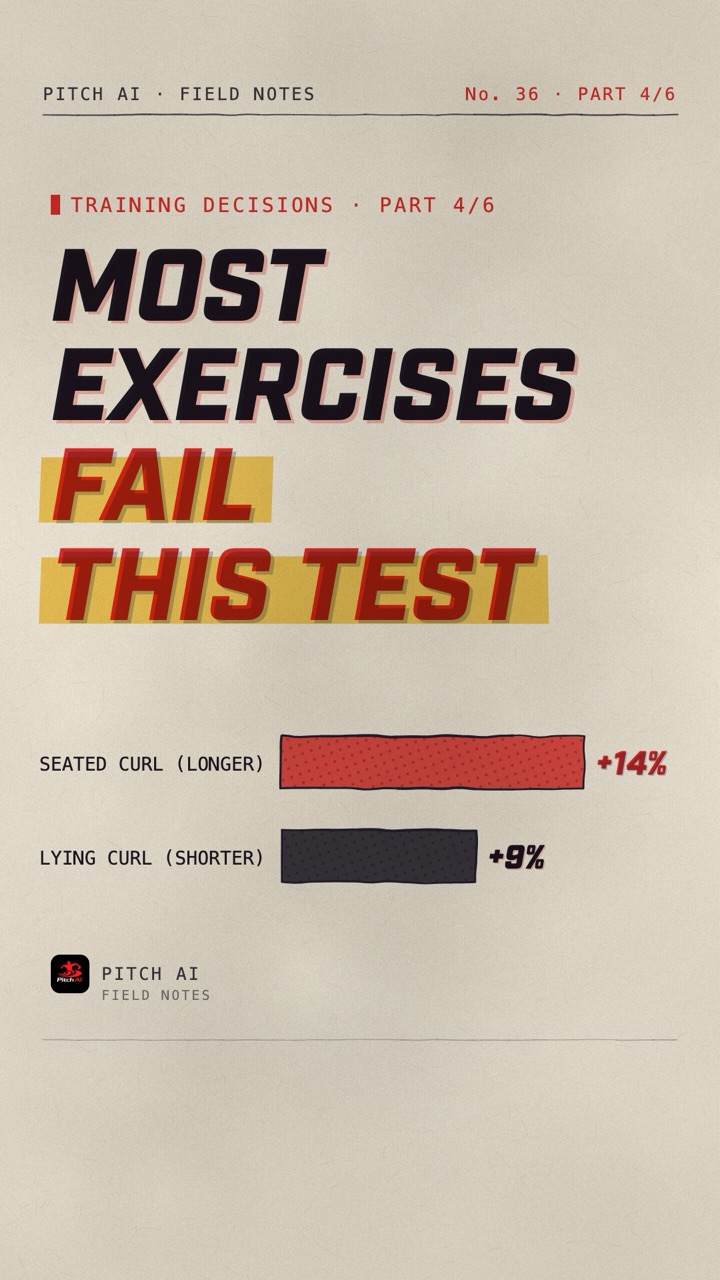
Yes, and the stretched position seems to matter most. In a 12-week study by Maeo and colleagues, 20 adults trained one leg with seated leg curls and the other with lying leg curls, using the same load and reps. The seated position works the hamstrings at longer lengths. Whole-hamstring volume grew about 14 percent with the seated curl versus about 9 percent with the lying curl [3].
Crider points to the same pattern in the lifts that have lasted for the back of the legs, such as Romanian deadlifts and Nordic curls, which load the muscle hard as it lengthens [1]. Zatsiorsky gives similar advice for young athletes, saying they should train the major muscle groups through the full range of joint motion [7].
Progress you can see
Log every lift, watch it climb
Pitch AI logs every strength session, so you can watch each lift progress and know whether an exercise is still paying off.


Are balance board and Swiss ball exercises good for pitchers?
Usually not as a main strength tool. Unstable exercises feel hard, which makes them look effective, but they cap how much load you can use. In one lab study, leg extension force was about 70 percent lower when eight men did the movement seated on a Swiss ball instead of a stable bench [4]. Pushing as hard as they could, they produced less than a third of their normal force.
The Canadian Society for Exercise Physiology reached a similar conclusion in its position stand. Ground-based free-weight lifts like squats and deadlifts can activate the core as much as or more than unstable exercises, while allowing far heavier loads [5]. The NSCA's textbook agrees that there seems to be no need to add instability to traditional free-weight training for strength and power [6]. Balance work can still have a place in rehab or as a small skill piece. It just should not replace the lifts that can actually progress.
The trade-off between perfect mechanics and room to grow
Crider admits there is always a trade-off [1]. The exercise that most closely matches a muscle's ideal line of pull may be awkward to load heavily. The exercise that is easiest to load may not hit the target well. Look for the middle, a lift that trains the right thing well enough and can keep progressing for a long time. That also means you do not need a new exercise every few weeks. Small tweaks for variety are fine, but the main lifts can stay for months, which our article on changing workouts every few weeks covers in detail.
Good exercise choices for common pitching goals
| Goal | Strong choices | Why they progress well | Weaker substitute |
|---|---|---|---|
| Lower-body strength | Trap bar deadlift, split squat, goblet or front squat | Easy to add load and range, stable | Squats on a balance board |
| Hamstrings | Romanian deadlift, Nordic curl, seated leg curl | Load at long muscle lengths, long levers | Light band leg curls only |
| Speed and power | Sprints, jumps, med ball throws | Always room to go faster, easy to add mass | Slow, grinding circuits |
| Upper back and trunk | Rows, chin-ups, carries | Simple to add load and reps | Endless novelty core moves |
Those are general examples, not a prescription. Your choices should fit your training age, injury history and season. The ideas behind what training actually transfers to pitching velocity help you decide how much of the program should look like throwing and how much should build general strength.
How to audit your current program
- Next to each exercise, write the one adaptation it is there for.
- Mark which of the four levers you can still push on it.
- Cross off anything with no clear target or fewer than two levers left.
- Check that the rest of your week is not already giving the same stimulus.
- Keep the survivors long enough to see progress, and log every session so you can see it.
Common exercise selection mistakes
- Choosing by how hard it feels. Wobbly, awkward or exhausting does not mean effective.
- Chasing novelty. A new exercise every week makes it impossible to progress any of them.
- Picking "baseball-looking" lifts by default. Mimicking the throw with a band does not make it a better strength exercise.
- Ignoring pain. If an exercise hurts a joint, swap it and talk to a qualified clinician instead of pushing through.
This article is part 4 of our Training Decisions series. The other parts cover part 1 on how much risk a pitcher should take in training, part 2 on how many throws a velocity day needs, part 3 on whether old school training methods still work, part 5 on how college pitchers should train from fall to winter, and part 6 on what pitchers can learn from wrestlers about mobility.
Frequently asked questions
How do you choose the right exercises for pitchers?
Ask two questions. What adaptation do you want, such as strength, muscle size or speed? And can the exercise keep progressing in load, range, lever length or speed? Keep exercises that answer both well. [1]
Are Nordic curls good for baseball players?
They are one of the best-supported injury prevention exercises in sport. A meta-analysis of 15 studies and 8,459 athletes found programs including Nordics cut hamstring injuries by about half, though most of the data comes from running sports. [2]
Is training on a balance board or Swiss ball good for strength?
Not as a main strength method. Leg extension force was about 70 percent lower on a Swiss ball in one study, and a Canadian position stand found ground-based free weights can train the core while allowing heavier loads. [4, 5]
How long should a pitcher keep the same exercises?
If an exercise trains the right adaptation and can still progress, it can stay in the program for months or longer, with small tweaks for variety. [1]
Pick it, then push it
Keep your best lifts moving up
Pitch AI logs every strength session, so you can see each lift progress week to week and keep the exercises that are actually moving.
References
- Crider B (2024). The principles of quality exercise selection. bricecrider.com (blog), September 24, 2024. https://www.bricecrider.com/blog/t
- van Dyk N, Behan FP, Whiteley R (2019). Including the Nordic hamstring exercise in injury prevention programmes halves the rate of hamstring injuries: a systematic review and meta-analysis of 8459 athletes. British Journal of Sports Medicine, 53(21), 1362-1370. https://doi.org/10.1136/bjsports-2018-100045
- Maeo S, Huang M, Wu Y, et al. (2021). Greater hamstrings muscle hypertrophy but similar damage protection after training at long versus short muscle lengths. Medicine and Science in Sports and Exercise, 53(4), 825-837. https://doi.org/10.1249/MSS.0000000000002523
- Behm DG, Anderson K, Curnew RS (2002). Muscle force and activation under stable and unstable conditions. Journal of Strength and Conditioning Research, 16(3), 416-422. PMID 12173956.
- Behm DG, Drinkwater EJ, Willardson JM, Cowley PM (2010). Canadian Society for Exercise Physiology position stand: the use of instability to train the core in athletic and nonathletic conditioning. Applied Physiology, Nutrition, and Metabolism, 35(1), 109-112. https://doi.org/10.1139/H09-128
- Haff GG, Triplett NT, eds. (2016). Essentials of Strength Training and Conditioning, 4th ed. Human Kinetics. (Instability training and free weights, p. 412.)
- Zatsiorsky VM, Kraemer WJ (2006). Science and Practice of Strength Training, 2nd ed. Human Kinetics. (Exercise selection for beginning and qualified athletes.)
- Blazevich AJ (2017). Sports Biomechanics: The Basics, 3rd ed. Bloomsbury. (Torque and moment arms.)