
A pitcher should take enough training risk to force real adaptation, and avoid any risk he could not recover from. That sounds obvious, but most training mistakes come from getting one half wrong. Some pitchers chase the next level with spikes in throwing and max-effort days they never built up to. Others play it so safe that their arm, body and velocity never get a reason to change. Coach Brice Crider argues that both paths can end a career. This guide explains why, what the research says about workload and injury, and a simple way to sort the risks in your next training block.
What are the two ways a pitching career ends?
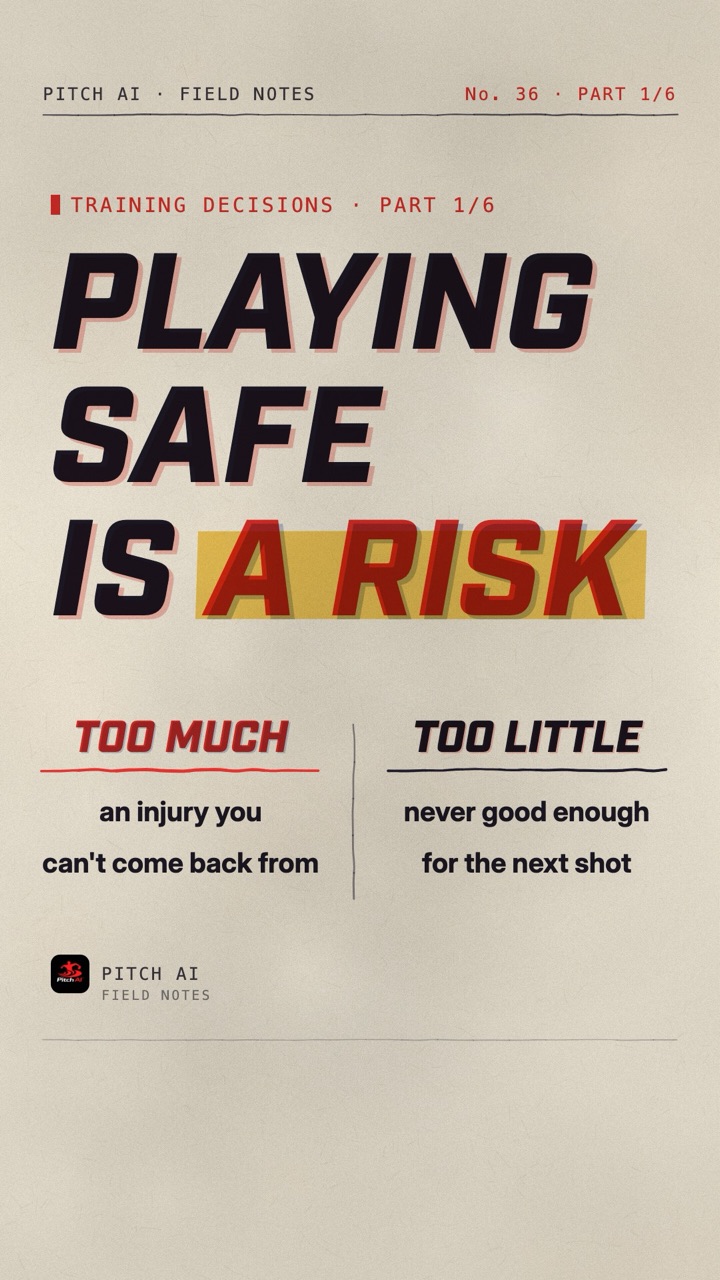
In his essay "Throw at Your Own Risk," Crider says an athlete's path is limited by two things at once [1]. You have to stay good enough to keep getting chances, and you have to stay healthy enough to handle the training that makes you better. Lose either one and the path stops. He compares it to the Icarus myth. Fly too high and the wings burn. Fly too low and the waves of ordinary performance swallow you.
Classic training theory says the same thing in drier language. Bompa and Haff describe a load that never rises as leading to a plateau, because the body has nothing new to adapt to. A load that is too large or too varied leads to maladaptation, where performance drops and injury or overtraining becomes likely [5]. Both outcomes are failures. One is just quieter than the other.
Can any program make a pitcher injury proof?
No, and it is worth being suspicious of anyone who says otherwise. Crider is blunt that injuries are part of high-level sport and always will be [1]. The numbers back him up. In a survey of 5,088 professional players, 25 percent of major league pitchers (96 of 382) and 15 percent of minor league pitchers had a history of Tommy John surgery. Most of the minor leaguers had their surgery in high school or college, before they ever reached pro ball [3].
That does not mean injury is random or that nothing helps. It means the honest goal is to lower the odds and limit the damage, while still training hard enough to improve. A plan that promises zero injuries usually gets there by asking for almost nothing, and then the athlete loses on the other side of the ledger.
Why your risk is not the same as your team's risk
Crider borrows an idea from economics called ergodicity [1, 2]. Here is the plain version. When you roll a die thousands of times, your own average ends up matching the average of everyone else's rolls. Bad rolls get balanced out by good ones. Economist Ole Peters points out that many real situations do not work that way, because one bad outcome can knock you out of the game for good. A bankrupt investor does not get to keep playing and wait for the average to catch up [2].
A pitcher's career is like the investor, not the die. An organization with 100 pitchers can play the averages. If an aggressive velocity program helps 80 of them and hurts a few, the team may come out ahead. You only get one arm and one career, so a serious injury is not a statistic you can average away. Crider's point is that a player development department and an individual athlete should think about the same risk differently, and both should agree on what the player is worth and how much risk it will take to grow that value [1].
Small risks also stack. Say a poorly planned training block carries a 5 percent chance of a serious setback. That sounds small. Run ten of those blocks across a high school and college career and the chance of at least one setback climbs to about 40 percent. Cut the per-block risk to 2 percent with better planning and the ten-block number falls to about 18 percent.
Push without spiking
See your workload trend before you ramp
Pitch AI shows your acute-to-chronic workload trend, so you can push into a new training block without spiking your throwing.


Which risks are worth taking in pitching?
The useful question is not "is this risky?" but "if this goes wrong, can I come back from it, and is the reward worth it?" Crider frames the coach's job as building a risk and reward portfolio that matches the stimulus the athlete needs [1]. Driveline's Hacking the Kinetic Chain makes a similar point, saying their programs are written around the risk and reward of each type of athlete rather than one plan for all [6]. Sorting your training into four boxes makes this concrete.
| Training choice | Why it is risky | How to make it a recoverable risk |
|---|---|---|
| A high-intent velocity block | More stress on the elbow and shoulder per throw | Build up for several weeks first, keep the hard days to a planned number, check readiness each day |
| Adding weighted balls | Unfamiliar loads and higher arm speed | Start light in dose, progress one variable at a time, stop at pain |
| Heavier lifting | Technique breaks down under fatigue | Coached technique, gradual load increases, sets stopped before form fails |
| Pitching through elbow pain | Can turn a small problem into surgery | Not worth it. Stop and see a qualified clinician |
| A sudden jump in throwing after time off | The arm has lost tolerance for the load | Ramp back over weeks, not days |
Does building up to high workloads protect pitchers?
The best evidence on this question comes from team sports outside baseball. In a widely cited review, Tim Gabbett concluded that athletes who are used to high training loads tend to have fewer injuries than athletes training at lower loads. The danger sits in large, rapid jumps in load, not in hard work itself [4]. That is the core reason training too little is not as safe as it looks. A pitcher who never builds capacity has less margin when the season, a showcase or a long outing suddenly asks for more.
Be honest about the limits. Most of this research comes from rugby, cricket and soccer, and baseball data on acute and chronic workload is smaller and more mixed. It is still the most practical framework we have, and it points the same way as the training theory. Build the base gradually, then use it. Our guide to pitching workload and arm health covers the acute-to-chronic ratio in detail, and how fast pitchers should progress their training explains why waves beat straight lines.
Crider quotes strength coach Stan Efferding making the hardest version of this argument. Efferding says athletes chasing the top have to keep taking their bodies somewhere new, and that pushing into that territory carries real risk even when it is done carefully [1]. You do not have to agree with every word to accept the core point. If you never go beyond what you can already do, you should not expect to become more than you already are.
How to set a risk budget for your next training block
Use this five-step check before a new block, whether it is an offseason velocity phase or a new lifting program.
- Name the reward. Write down the one thing the block is for, such as two more miles per hour, a stronger lower half, or a pitch that holds up for 80 pitches.
- Rule out the risks you cannot come back from. No throwing through pain, no max-intent days you have not built up to, and no sudden doubling of throws after a break.
- Choose the risks you will take on purpose. A built-up velocity block or heavier lifting is a reasonable risk if it is ramped and coached.
- Ramp, then hold. Increase throwing in steps over several weeks so your recent load never races far ahead of what you have been doing for the past month.
- Check readiness every day. Sleep, soreness, arm feel and any pain decide whether today's hard day stays hard. Pain is a stop sign, not a data point to push through.
For pitchers under 18, MLB and USA Baseball's Pitch Smart pitch counts and rest rules are the floor, not the plan [7]. The way to handle more later is to build capacity steadily now, which our safe pitching guidelines article walks through by age.
Common mistakes when thinking about training risk
- Treating rest as automatically safe. Long stretches of very low throwing leave the arm unprepared for the load that comes next.
- Copying a pro or a teammate's program. Their capacity, history and goals are not yours. Our article on why the same program works for one kid and not another explains why.
- Counting only game pitches. Bullpens, long toss, drills and warm-ups are workload too.
- Hiding pain to stay on schedule. That is the one risk with almost no upside.
- Changing everything at once. A new ball weight, a new delivery and a new lifting plan in the same week makes it impossible to know what helped or hurt.
This article is part 1 of our Training Decisions series. The other parts cover part 2 on how many throws a velocity day needs, part 3 on whether old school training methods still work, part 4 on how to choose exercises that keep paying off, part 5 on how college pitchers should train from fall to winter, and part 6 on what pitchers can learn from wrestlers about mobility.
Frequently asked questions
Is it possible to prevent all pitching injuries?
No. Injuries are part of high-level sport. In one survey of 5,088 professional players, 25 percent of major league pitchers had a history of Tommy John surgery. Good training lowers the odds and limits the damage, but no program can promise zero injuries. [1, 3]
Is training too little risky for pitchers?
Yes, in two ways. A load that never rises leads to a plateau, so the pitcher may not earn the next opportunity. And athletes who are not built up to high workloads have less margin when the season suddenly asks for more. [4, 5]
What is the ergodicity problem in sports?
It is the idea that the average outcome across many athletes can differ from what one athlete experiences over time. A team can absorb a few injuries across 100 pitchers, but one pitcher cannot average away a career-ending injury, so individuals should weigh unrecoverable risks more heavily. [1, 2]
Which training risks should pitchers avoid completely?
Throwing through elbow or shoulder pain, sudden large jumps in throwing after time off, and max-intent work the arm has not been built up to. These carry a long road back for little reward. Pain means stop and see a qualified clinician. [4]
Take the right risks
Ramp up with your workload in view
Pitch AI shows your acute-to-chronic workload trend, so you can ramp up without spiking and keep building the capacity the next level asks for.
References
- Crider B (2025). Throw at Your Own Risk. bricecrider.com (blog), March 27, 2025. https://www.bricecrider.com/blog/throw-at-your-own-risk (includes the Stan Efferding quote paraphrased above).
- Peters O (2019). The ergodicity problem in economics. Nature Physics, 15, 1216-1221. https://doi.org/10.1038/s41567-019-0732-0
- Conte SA, Fleisig GS, Dines JS, et al. (2015). Prevalence of ulnar collateral ligament surgery in professional baseball players. American Journal of Sports Medicine, 43(7), 1764-1769. https://doi.org/10.1177/0363546515580792
- Gabbett TJ (2016). The training-injury prevention paradox: should athletes be training smarter and harder? British Journal of Sports Medicine, 50(5), 273-280. https://doi.org/10.1136/bjsports-2015-095788
- Bompa TO, Haff GG (2009). Periodization: Theory and Methodology of Training, 5th ed. Human Kinetics. (Chapter 1, load and adaptation.)
- Boddy K, Daniels M (2017). Hacking the Kinetic Chain: Advanced Pitching. Driveline Baseball.
- MLB and USA Baseball. Pitch Smart: Pitching Guidelines. https://www.mlb.com/pitch-smart/pitching-guidelines