
For a healthy college pitcher with no arm pain who threw a full fall, coach Clayton Thompson argues that winter does not have to start with a shutdown. He treats fall ball as the build-up phase and winter as a four-week sharpening phase. Total throws come down each week, the allowed velocity drop-off gets tighter so more throws land near your best, and the weight room follows the same path toward fewer, faster sets [1]. This guide explains that plan, the evidence around it, and who it is and is not for. High school pitchers should still follow Pitch Smart's yearly rest rules first [4].
Should college pitchers shut down after fall ball?
Thompson's article starts with a message from a Power 5 pitcher sitting 90 to 92 mph. With two years of eligibility left, the pitcher did not think there was time for a full shutdown and asked about a light deload instead [1]. Thompson's first move was to ask questions. Was there any arm pain? How often was he lifting? How did he perform? How much had he been throwing? From his own college experience, he expected no pain, solid outings, four lifts a week and enough build-up to throw five innings. In that case, he asks, why take a break at all?
His wider argument is that velocity comes from frequent, intent-filled throwing, so long breaks cost a pitcher who still needs to gain speed. If the fall did not go well, he would spend winter on the mound and against hitters rather than only throwing into a net [1].
This is one coach's view in a real debate. Other coaches prefer a planned break after a long year to let the arm recover. Both camps agree on the essentials. Pain changes everything, the rest you already took this year matters, and your team's medical and coaching staff have the final say. Our guide to how much time off a pitcher should take covers the rest side, and Pitch Smart asks pitchers aged 15 to 18 to take at least four months off from competitive pitching each year [4].
Why fall ball counts as the accumulation phase
If you have been throwing consistently since late summer, Thompson says you have probably already finished the accumulation phase [1]. That is the high-volume part of a plan, where fatigue and workload build up and the tissues adapt. It usually contains an on-ramp for durability and a velocity phase at high speed and volume. In the fall, that volume comes from everywhere, including at least a couple of innings a week, a midweek bullpen, long toss, fielding practice and bullpen drills.
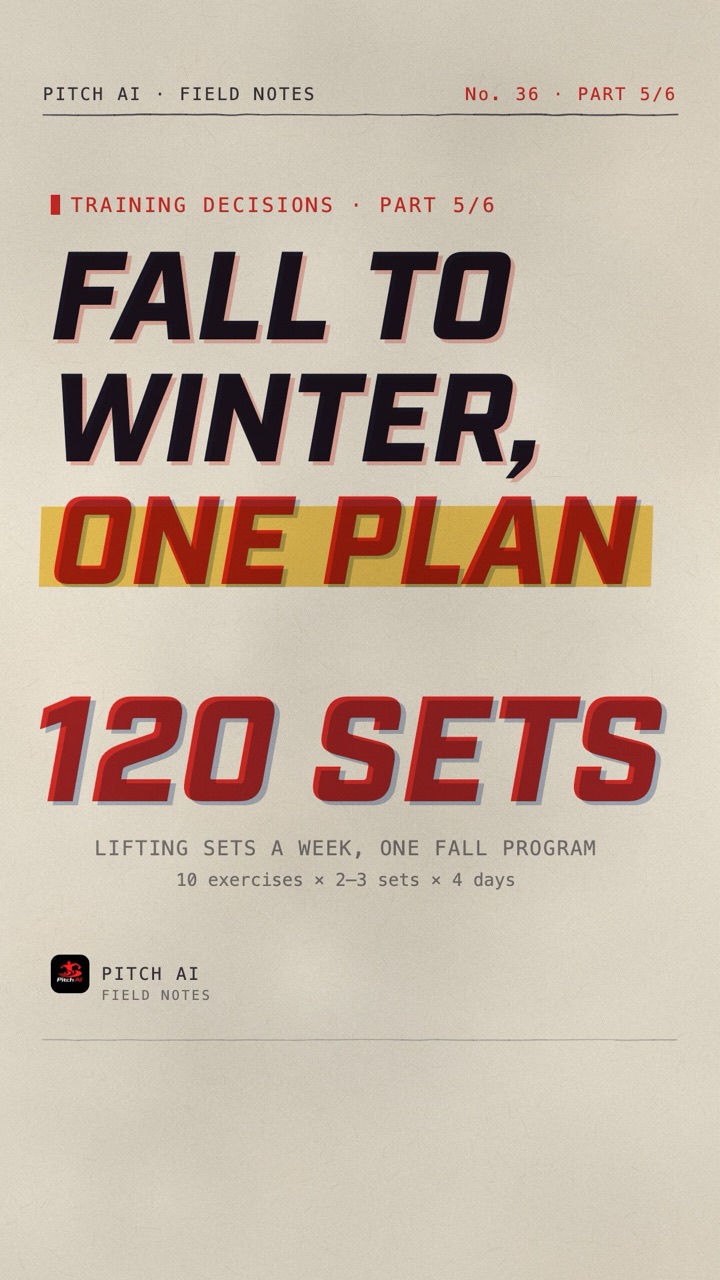
The weight room adds its own volume. Thompson reviewed one fall program with 10 exercises of 2 to 3 sets, four days a week, which he works out to about 120 sets a week [1]. He calls the program reasonable, with standard rep ranges and a good activation block. The point is that a lot of adaptation has been built, and winter is the time to cash it in.
This sequence, a volume block followed by a sharper block with less work, is old and well described. Zatsiorsky outlines accumulation, transmutation and realization blocks, and notes that the gains from heavy work often show up two to six weeks after the load comes down [5]. Our article on planning a pitcher's offseason with phase potentiation explains the full-year version.
Why strength and pitching coaches need one plan
Thompson's bigger complaint is that in many college programs the strength coach and the pitching coach work separately, even though they want the same result [1]. The strength coach chases bigger, faster and stronger. The pitching coach chases velocity. Gains in muscle and force are valuable, he argues, but only as a means to throwing harder. A "performance" program judges itself by what happens on the mound, not by the numbers on the bar.
Phase-aware throwing
A throwing program that knows your season
Pitch AI's throwing program changes with your season phase, with a six-week preview, so the move from fall volume to winter speed is planned ahead.


What changes in the four-week winter phase?
Thompson says he used to schedule deloads all at once. After studying Daniel Bove's Quadrant System, he moved to a phase that starts with higher volume and more fatigue and then tapers on its own, so no separate deload or time off is needed [1, 2]. Four things change across the four weeks.
- Total throwing volume goes down week by week.
- The allowed drop-off gets tighter, so a session ends sooner once velocity slips. That keeps a larger share of throws near your top speed.
- An underload ball is added to prepare for top-end arm speed.
- Hybrid days sit before high-velocity days to prime faster movement, and he lets athletes add a rest day between them if they need it.
A drop-off means you stop once your throws fall a set percentage below today's peak velocity, not your personal record. Part 2 of this series explains how velocity drop-offs work and how to choose one.
The underload piece has some direct research. In a 10-week study, 24 adolescent players trained three times a week with either a 4.4-ounce ball or a regulation 5-ounce ball. The lighter-ball group improved throwing velocity and arm speed, and the regulation group did not [3]. That was one small study in younger players, so treat it as support, not proof. Thompson's own explanation, that fast throws teach the nervous system to feel safe at high speed, is his coaching view. Our weighted ball training guide covers dosing and risk.
How the weight room should mirror the throwing
Thompson's key point for lifting is that it should follow the same shape as the throwing. Across the four weeks, sets and reps come down while speed and intent go up [1]. He uses an undulating model, where loads and speeds shift from day to day to match the throwing focus.
He describes the heavy, tissue-fatiguing lifts as Bove's Quadrant 2 and tapers them gradually rather than cutting them all at once. Lower-volume, high-speed work, his Quadrant 3, fits on the lighter middle velocity day so the athlete is fresh for the big session later in the week. Near the end of the phase, some heavy lifts can shift toward lighter, faster versions [1, 2]. We have not read Bove's book directly, so these labels are as Thompson applies them.
Bompa and Haff describe the goal of any taper the same way. Clear the built-up fatigue while keeping the fitness, and do not let the reduction drag on so long that fitness starts to fade [6]. For the rest of the week around these sessions, our guide to a pitcher's weekly training schedule shows how to stack lifts on high days.
Who this winter plan is for
- Healthy college pitchers with no arm pain. Any pain means stop and see a qualified clinician before planning anything else.
- Pitchers who already rested this year. If you have not had a real break in 12 months, start there.
- Pitchers who built up through the fall. The phase assumes a big base of throwing already exists.
- Not high school pitchers by default. Follow Pitch Smart's yearly time off and the guidance of your coaches first [4].
Common fall to winter mistakes
- Shutting down by habit. A break should be a planned decision based on pain, workload and rest so far, not a calendar default.
- Keeping fall volume all winter. Volume has to come down for the speed to show up.
- Dropping heavy lifting overnight. Taper it across the weeks.
- Throwing only into a net. If your fall was rough, winter is the time for mound work and live hitters.
- Two coaches, two calendars. Get the lifting and throwing plans on the same page.
Want a starting template? Our free college pitcher velocity program lays out a six-week block that you can adapt with your coaches.
This article is part 5 of our Training Decisions series. The other parts cover part 1 on how much risk a pitcher should take in training, part 2 on how many throws a velocity day needs, part 3 on whether old school training methods still work, part 4 on how to choose exercises that keep paying off, and part 6 on what pitchers can learn from wrestlers about mobility.
Frequently asked questions
Should college pitchers stop throwing after fall ball?
It depends on arm health, how much rest you already took this year and your team's plan. Coach Clayton Thompson argues that a healthy pitcher with no arm pain who built up through the fall can skip a full shutdown and move into a tapering winter phase instead. [1]
What is an intensification phase for pitchers?
It is a block after a high-volume phase where total throwing goes down while intensity goes up. In Thompson's four-week version, the allowed velocity drop-off gets tighter each week, an underload ball is added, and lifting moves toward fewer, faster sets. [1]
Do underload baseballs increase velocity?
One 10-week study of 24 adolescent players found that training with a 4.4-ounce ball increased throwing velocity while a regulation-ball group did not change. It is a small study, so treat it as support rather than proof. [3]
Does this apply to high school pitchers?
Not by default. Pitch Smart asks pitchers aged 15 to 18 to take at least four months off from competitive pitching each year, including two to three continuous months off from overhead throwing. [4]
Plan the winter
Let your program change with the season
Pitch AI's throwing program changes with your season phase, with a six-week preview of what is coming, so your fall build turns into spring velocity.
References
- Thompson C (2024). Transitioning From Fall to Winter Training: A Unified Approach to Build Throwing Velocity. Medium (blog), November 5, 2024. https://medium.com/@cl4ytonthompson/from-fall-ball-to-winter-training-13e15d0ded02
- Bove D (2022). The Quadrant System: Navigating Stress in Team Sport. (As applied to lifting by Thompson; not read directly.)
- Yang WW, Liu YC, Lu LC, et al. (2013). Performance enhancement among adolescent players after 10 weeks of pitching training with appropriate baseball weights. Journal of Strength and Conditioning Research, 27(12), 3245-3251. https://doi.org/10.1519/JSC.0b013e31828ddfeb
- MLB and USA Baseball. Pitch Smart: Pitching Guidelines. https://www.mlb.com/pitch-smart/pitching-guidelines
- Zatsiorsky VM, Kraemer WJ (2006). Science and Practice of Strength Training, 2nd ed. Human Kinetics. (Accumulation, transmutation and realization; delayed transformation.)
- Bompa TO, Haff GG (2009). Periodization: Theory and Methodology of Training, 5th ed. Human Kinetics. (Tapering.)