
Some old school training methods are still among the best tools a pitcher has, and some deserved to die. The ones that last tend to be built on principles that do not change, like overload, recovery and specificity. Coach Brice Crider calls this "Lindy training," after an idea that the longer something has survived, the longer it is likely to keep surviving. This article explains that test, shows which old methods passed it, which old beliefs failed it, and gives you three questions to ask before you buy into the next training trend.
What is the Lindy effect?
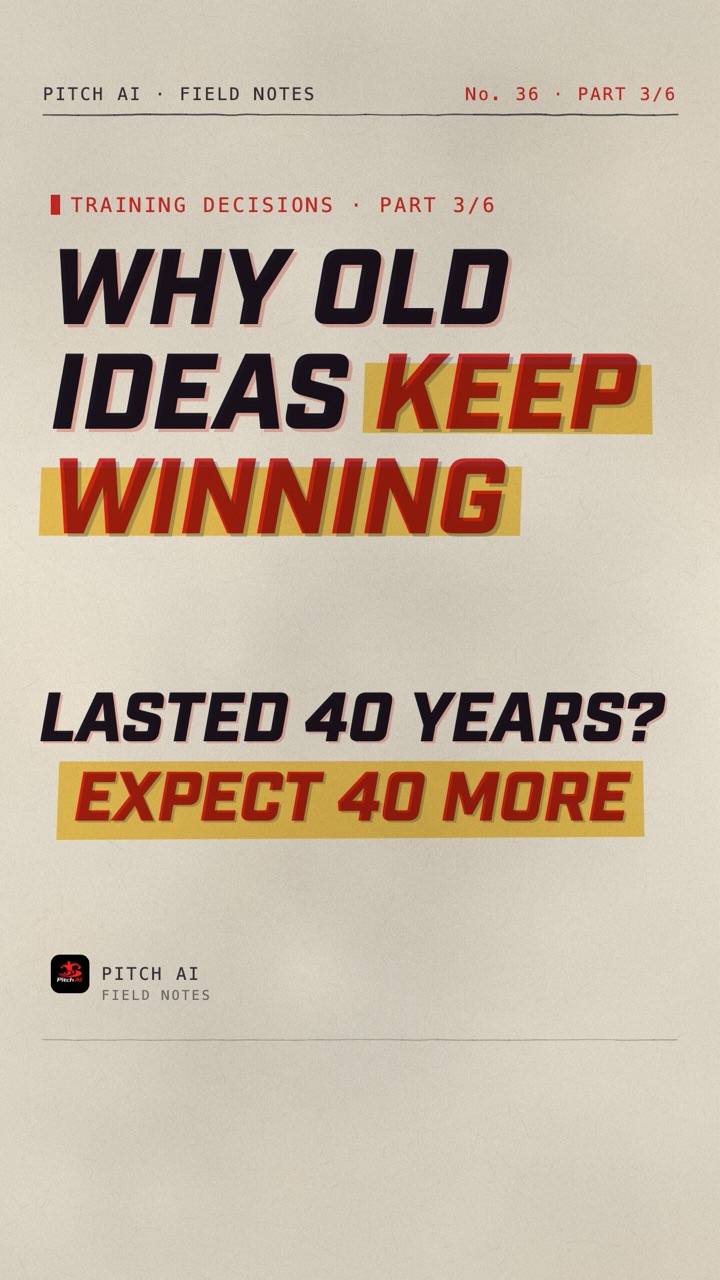
The Lindy effect is a rule of thumb for things that do not wear out, such as ideas, books and methods. The writer Nassim Taleb popularized it in his book Antifragile. His version says a book that has been in print for 40 years can be expected to stay in print for about 40 more, and if it survives another ten, its expected future grows again [2]. The idea started with a 1964 magazine piece by Albert Goldman about comedians at Lindy's deli in New York and was later worked out mathematically by Benoit Mandelbrot [2].
Crider applies the same lens to training [1]. A method that has worked across decades, sports and countries has been tested by more athletes and more coaches than any single study could manage. That long survival is weak proof on its own, but it is real information. A brand-new method has not been tested by time at all.
Old school training methods that still work
Three rising sets. In the 1940s, Dr. Thomas DeLorme used weight training to rehabilitate injured World War II servicemen. He first thought 7 to 10 sets were needed, then cut it to 3. The first set used 50 percent of the lifter's 10-rep max, the second 75 percent and the last 100 percent [3, 4]. Dan John, writing in Easy Strength, says plainly that the system still works and that nothing he has tried beats it by much [4]. Plenty of modern programs still ramp up through their sets in a very similar way.
Stress, recover, adapt. Hans Selye described how the body responds to stress in 1936 [5]. Almost every periodization model since, including Bompa's yearly training plan, rests on that cycle of load, fatigue and adaptation [9]. Our article on recovery and adaptation for pitchers covers how it plays out across a pitcher's week.
High and low days. Sprint coach Charlie Francis separated truly intense work from easy work so the nervous system could recover between hard days, noting that low-intensity work leaves it largely intact [8]. Crider lists Francis's system among the simple ones still used today [1]. We explain how to apply it in should pitchers throw hard every day?
Lighter and heavier implements. Long before weighted baseballs, track and field throwers trained with lighter, heavier and standard implements. Anatoliy Bondarchuk's work with hammer throwers describes how each weight transferred differently to competition results [10]. Weighted ball training for pitchers is a newer application of that old idea, with its own risks, which our weighted ball training guide lays out.
Principles vs methods in pitching training
Crider's most useful point is the difference between principles and methods [1]. Principles are the rules training has to obey. He lists the basic dials of any program, which are volume, intensity, frequency and density, along with the laws of physics, the general adaptation cycle, and physical qualities like strength, power, speed, coordination and mobility. Those have barely changed in a century. Methods are the specific tools, drills and gadgets used to apply the principles, and they change constantly.
Seen that way, a lot of modern training technology is old wisdom with better measurement. A sleep tracker confirms what your grandmother told you about sleep. Motion capture quantifies what good coaches have always tried to see with their eyes [1]. That is not a knock on technology. Precise measurement can show you which old idea is working for you and which is not. It just means the tool should be judged by which principle it helps you apply.
Principles in one plan
Build the basics around your season
Pitch AI builds strength, workload and velocity work into one plan around your season, so overload and recovery are planned instead of guessed.


Is old school always right? The muscle-bound myth
No. Age alone proves nothing, and Crider says so directly. A method that has lasted has usually lasted because some part of it follows the principles, not because it is old [1]. Some old beliefs were simply wrong.
For decades, coaches warned athletes that lifting weights would make them slow and "muscle-bound." Springfield College physiologist Peter Karpovich believed it too, until he tested it. In a 1951 study with William Zorbas, he compared the speed of muscle contraction in three groups, sedentary liberal arts students, athletic physical education students and experienced weightlifters. The weightlifters were the fastest [6, 7]. Karpovich changed his mind, and the myth slowly lost its grip, although you still hear versions of it about pitchers today. We have not read the original 1951 paper, so we are relying on a historical account of it for these details [7].
The lesson is that the Lindy filter is a starting point, not a verdict. An old idea earns trust by surviving honest tests, and the "lifting makes you slow" belief survived for a long time mostly because nobody tested it.
Why simple training systems last
Crider compares training to cooking [1]. Cuisines around the world look different, but nearly all of them combine a carbohydrate, a protein, fat and some fruits and vegetables, prepared to suit local conditions. The best meals are often the simplest ones made with good ingredients. Training systems that last look the same way. They keep the principles simple, build general strength and movement quality, center everything on the sport skill, and adjust to the athlete's situation.
That has a practical upside for pitchers. If a program needs a long explanation of why it is different from everything else, be cautious. If it looks like sensible overload, real recovery and plenty of throwing, built around your season, it is probably standing on solid ground.
How to use the Lindy filter on a new training trend
Before you add the next drill or device you see online, run it through three questions.
| Trend | Principle it serves | Old idea behind it | How to test it |
|---|---|---|---|
| Bar speed tracking | Effort and fatigue | Stopping a set before form breaks | Watch your strength and jump trend over 8 weeks |
| Weighted balls | Overload and specificity | Heavier and lighter throwing implements | Track velocity and arm feel through a planned block |
| Sleep trackers | Recovery | Sleep more when training is hard | Compare readiness on long and short nights |
| Balance board lifting | Unclear for strength | None that lasted for strength | Part 4 explains why this one usually fails |
The last question matters most. Track the outcome you care about before and after you add the method, and give it long enough to work. One great bullpen is not a test.
Common mistakes with old and new methods
- Rejecting anything new. Every old method was new once. The filter is meant to make you curious and careful, not closed.
- Trusting anything old. The muscle-bound myth was old too. Ask whether it survived testing or just survived habit.
- Confusing the tool with the principle. Buying a device does not apply overload or recovery for you. How you use the information does.
- Changing methods every few weeks. Constant novelty makes progress hard to see. Our article on whether pitchers should change their workout every few weeks covers how long to stick with a plan.
This article is part 3 of our Training Decisions series. The other parts cover part 1 on how much risk a pitcher should take in training, part 2 on how many throws a velocity day needs, part 4 on how to choose exercises that keep paying off, part 5 on how college pitchers should train from fall to winter, and part 6 on what pitchers can learn from wrestlers about mobility.
Frequently asked questions
What is the Lindy effect in training?
It is the idea that for things that do not wear out, like methods and ideas, a long survival so far predicts a long future. In training, methods that have worked for decades usually follow lasting principles such as overload and recovery. [1, 2]
Is the DeLorme method still used?
Yes. DeLorme's 1948 system of three sets of 10 at 50, 75 and 100 percent of the 10-rep max still shows up in many programs, and Dan John writes in Easy Strength that the system still works. [3, 4]
Does lifting weights make athletes slow?
No. In a 1951 test by Zorbas and Karpovich, experienced weightlifters had faster muscle contraction speed than athletic physical education students and sedentary students. The muscle-bound idea was an old belief that did not survive testing. [6, 7]
Should pitchers avoid new training technology?
No. Many new tools measure old principles more precisely. Judge each one by which principle it serves and whether you can test it on your own results over several weeks. [1]
Simple, built to last
Put the lasting principles to work
Pitch AI builds strength, workload and velocity work into one plan around your season. The methods can change while the principles stay steady.
References
- Crider B (2024). Lindy Training: An Inquiry into Training Principles and Methodologies. bricecrider.com (blog), August 30, 2024. https://www.bricecrider.com/blog/lindy-training-an-inquiry-into-training-principles-and-methodologies
- Taleb NN (2012). Antifragile: Things That Gain from Disorder. Random House. (Lindy effect, after Goldman A, "Lindy's Law," The New Republic, 1964, and Mandelbrot B, 1982.)
- DeLorme TL, Watkins AL (1948). Technics of progressive resistance exercise. Archives of Physical Medicine and Rehabilitation, 29(5), 263-273. PMID 18860422.
- John D, Tsatsouline P (2011). Easy Strength. Dragon Door. (pp. 240-241 on the DeLorme method.)
- Selye H (1936). A syndrome produced by diverse nocuous agents. Nature, 138, 32. https://doi.org/10.1038/138032a0
- Zorbas WS, Karpovich PV (1951). The effect of weight lifting upon the speed of muscular contractions. Research Quarterly, 22(2), 145-148.
- Murray J (1997). Weightlifting's non-lifting patron saint. Iron Game History, 4(5-6). https://starkcenter.org/igh/igh-v4/igh-v4-n5-n6/igh0405c.pdf
- Francis C (1992). The Charlie Francis Training System. TBLI Publications.
- Bompa TO, Haff GG (2009). Periodization: Theory and Methodology of Training, 5th ed. Human Kinetics.
- Bondarchuk AP (2010). Transfer of Training in Sports, Volume II. Translated by M Yessis. Ultimate Athlete Concepts.