
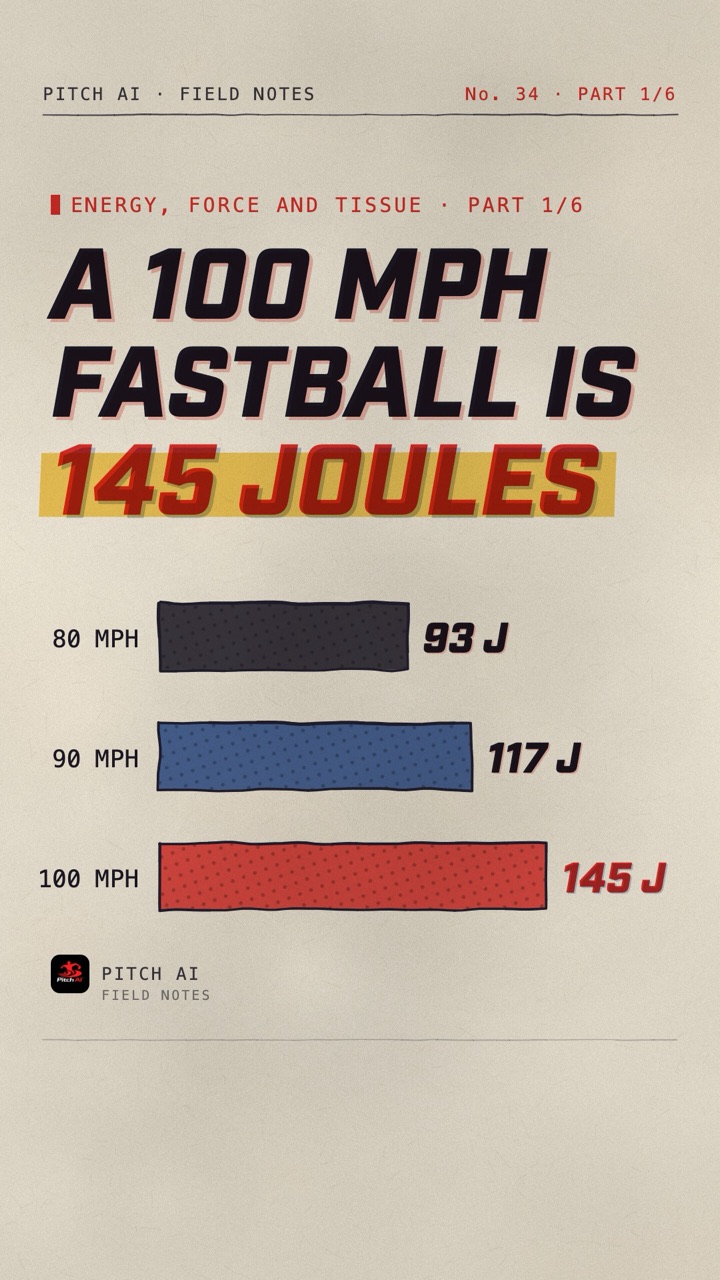
A 100 mph fastball carries about 145 joules of kinetic energy. That comes from one line of school physics, half the ball's mass (0.145 kg) times its speed (44.7 meters per second) squared. The more interesting part is where those joules come from. Your body does not create any of them. It converts energy you already have, from food, from gravity and from stretched tissue, into a moving ball, and it loses some at every step. Understanding that chain changes how you think about training for velocity.
How do you calculate the energy of a fastball?
Kinetic energy is the energy an object has because it is moving. The formula is KE = ½ × m × v², where m is mass in kilograms and v is speed in meters per second. A regulation baseball weighs about 5 ounces, or 0.145 kg. One mile per hour is 0.447 meters per second, so 100 mph is 44.7 m/s. Put those in and you get 0.5 × 0.145 × 44.7 × 44.7, which is about 144.9 joules.
Clayton Thompson, a pitching coach who writes about the physics of throwing, opens his essay "Thermodynamics of Throwing" with this number (he rounds it to 144 J in one place and 142 J in another) [1]. The small gap is just rounding and ball weight. MLB balls range from 5 to 5.25 ounces, which shifts the answer by a few joules. Here is the same math at common speeds:
| Pitch speed | Meters per second | Kinetic energy | Momentum (and impulse needed) |
|---|---|---|---|
| 60 mph | 26.8 | 52 J | 3.9 N·s |
| 70 mph | 31.3 | 71 J | 4.5 N·s |
| 80 mph | 35.8 | 93 J | 5.2 N·s |
| 90 mph | 40.2 | 117 J | 5.8 N·s |
| 100 mph | 44.7 | 145 J | 6.5 N·s |
The last column is the ball's momentum, mass times speed. It also equals the push (force multiplied by time) the hand has to give the ball, which is the subject of part 3 on impulse.
Why does a few mph cost so much more energy?
Because speed is squared. Going from 90 to 100 mph is about 11% more speed, but it takes about 23.5% more energy in the ball (117 J to 145 J). Each extra mile per hour costs a little more than the one before it. Adding one mph at 90 takes about 2.6 J. Adding one at 99 takes about 2.9 J.
This is one reason velocity gets harder to add the higher you go. The body has to find more energy and get it into the ball within the same tiny window, while the tissue that passes it along carries more load. That trade-off is the theme of this whole series.
Where does the energy in a pitch come from?
Thompson builds his argument on the first law of thermodynamics. Energy is never created or destroyed. It only changes form. So when people say a pitcher "creates" velocity, what really happens is a chain of conversions [1]:
Chemical energy stored in your body becomes ATP, ATP powers the muscle proteins that pull on tendons, and that pulling moves your segments and finally the ball. Muscle is only one of the sources, though. A pitcher also borrows energy from gravity and from tissue that gets stretched during the delivery. We will come back to both.
How much energy does the body lose along the way?
A lot. The second law of thermodynamics says no conversion is perfect, and the body is no exception. Biomechanist Anthony Blazevich puts muscle efficiency at roughly 25%. Only about a quarter of the energy a muscle uses ends up as mechanical work. The rest becomes heat [2]. That is why you get warm when you train hard.
Losses keep happening after the muscle. Tendons and other connective tissue are not perfect springs. When they are stretched and released, some of the stored energy is lost as heat, a property called hysteresis. Friction between fingers and ball takes a little more. Thompson calls heat an unavoidable tax on every step of the throw [1].
None of this means a pitcher is wasteful. It means the 145 joules in the ball are only the visible tip of a much bigger energy budget that your fitness, your fuel and your recovery all have to support.
Train the whole chain
Build the engine behind your fastball
Pitch AI builds your throwing and strength work around how velocity is really made, with strength and nutrition plans and a velocity trend so you can see the engine grow.


How gravity and stretched tissue lend a pitcher energy
Gravity. When you lift your leg and then move down and forward, your center of mass falls a little. Falling turns stored height into motion. If a 190 pound (86 kg) pitcher's center of mass drops about 7 inches (0.18 m) between peak leg lift and foot strike, gravity frees roughly 86 × 9.81 × 0.18, or about 150 joules. That is in the same range as the ball's 145.
Two cautions. First, that energy shows up as body motion, mostly down and forward, and only part of it can be redirected into rotation and then into the ball when the front foot lands. Second, Thompson's essay quotes much larger potential energy numbers (over 1,000 J) measured from the plate. Those are true on paper, but your center of mass never falls that far during a pitch, so we use the smaller drop here [1]. Tread Athletics' Ben Brewster makes a related point about body weight. Extra mass raises the energy available, but it only helps velocity when it comes with the power to use it, which is why lean mass matters more than scale weight [7].
Elastic stretch. At layback, when the arm is cocked back as far as it goes, the front of the shoulder and trunk is stretched under load. A 2013 study in Nature by Neil Roach and colleagues filmed throwers in 3D and concluded that much of the power behind the very fast inward rotation of the upper arm comes from elastic energy stored and released at the shoulder, not from the shoulder muscles alone [3]. Blazevich explains why that matters. Stretched tendons recoil much faster than muscle can shorten, the same reason a slingshot beats a bare hand [2].
What the research does not tell us yet
The physics is solid. The ball needs about 145 J at 100 mph, and energy is conserved. What is still debated is how much each source adds in a real delivery. Thompson argues that the elastic stretch around layback is probably the largest single source of ball speed [1]. That is a reasoned view, not a measurement, and no study has split a pitch's energy cleanly into muscle, gravity and elastic shares.
What lab studies can measure is how energy moves between body segments. In youth pitchers, the amount of energy flowing from the trunk into the arm had the strongest link to pitch speed of anything measured (r = 0.90 in 24 pitchers) [5]. Adam Bloebaum's analysis of almost 18,000 tracked throws points the same way [4]. We dig into that in part 2, on whether the arm creates velocity or passes it on.
What does this mean for training?
Thompson borrows an idea from dynamical systems research, the study of how complex movements organize themselves [6]. How you set a system up decides where it can go next. His image is dominoes. A delivery spends its first part loading energy (height from the leg lift, stretch through the trunk and shoulder, fuel ready in the muscles), and then that energy can only run downhill in a few ways. Coaching, in his view, is mostly about setting up the dominoes well [1].
In plain terms, that gives four jobs:
- Build the engine in the gym: stronger legs and trunk and more lean mass raise the energy you can produce and handle. Our guide on what training transfers to velocity covers how to make that strength count on the mound.
- Load up, then move down the mound: a controlled leg lift and a stride that keeps moving let gravity help instead of stalling it.
- Let layback happen: forcing the arm back with effort is not the same as letting the trunk rotate and the arm lag. The stretch does the work when the body leads.
- Build the capacity to carry the load: more energy through the arm means more stress on it, so velocity work goes hand in hand with a ramped throwing workload and strength for the shoulder and elbow. See our arm care routine.
Common mistakes when thinking about velocity energy
- Thinking the arm makes the speed: the arm is the last link, and most of its energy arrives from the trunk. Muscling the ball adds effort and stress, not much speed.
- Treating 145 J as small: it is not a lot of energy in total, but it is delivered in a fraction of a second, so the power at the joints is very high.
- Gaining weight without power: mass only helps if you can move it fast. Fat mass adds load without adding output [7].
- Ignoring the energy bill: under-eating and short sleep shrink the budget every throw draws from.
Try this at your next session
Feel the elastic part for yourself. Do three jumps where you pause at the bottom for two seconds, then three where you dip and jump straight away. Most athletes jump higher with the quick dip, because the stretch stores energy that the pause lets leak away [2]. Then watch your delivery on video and ask whether your arm is lagging behind a rotating trunk, or racing ahead of it. Our article on what makes pitchers throw harder walks through the sequence from the ground up.
More from the Energy, Force and Tissue series
This article is part 1 of our Energy, Force and Tissue series. Each part takes one idea from physics or tissue science and turns it into a training decision.
- Part 2: Does your arm create velocity or pass it on?
- Part 3: What is impulse and why does it matter for pitchers?
- Part 4: How long does it take tendons to get stronger?
- Part 5: Should pitchers back squat?
- Part 6: Does your infrasternal angle decide your pitches?
Frequently asked questions
How many joules is a 100 mph fastball?
About 145 joules. A 0.145 kg baseball moving at 44.7 m/s has kinetic energy of ½ × 0.145 × 44.7², which is 144.9 J [1].
How much more energy does a 100 mph pitch have than a 90 mph pitch?
About 23.5% more, roughly 145 J versus 117 J, even though the speed is only about 11% higher. Energy rises with the square of speed.
Do pitchers create energy when they throw?
No. Energy cannot be created. The body converts chemical energy from food, plus energy from gravity and stretched tissue, into motion, and loses much of it as heat along the way [1, 2].
How efficient are human muscles?
Roughly 25%. Only about a quarter of the energy a muscle uses becomes mechanical work, and the rest is released as heat [2].
Where does most of the energy in a pitch come from?
Nobody has measured the exact split. Muscle work, gravity during the stride and elastic energy stored around the shoulder all contribute. Elastic storage at the shoulder is well supported [3], but the claim that it is the largest source is an expert opinion.
Velocity is converted energy
Get a plan built around it
Pitch AI builds your throwing and strength work around how velocity is really made. Programming adapts to your daily Wellness Check-In, and your velocity trend shows whether the work is landing.
References
- Thompson C. Thermodynamics of Throwing. Medium (practitioner essay). https://medium.com/@cl4ytonthompson/thermodynamics-of-throwing-dec97c369137
- Blazevich AJ (2017). Sports Biomechanics: The Basics. Optimising Human Performance, 3rd ed. Bloomsbury. Chapters 17 and 18.
- Roach NT, Venkadesan M, Rainbow MJ, Lieberman DE (2013). Elastic energy storage in the shoulder and the evolution of high-speed throwing in Homo. Nature, 498(7455), 483-486. https://doi.org/10.1038/nature12267
- Bloebaum A (2025). Energy Flow Dynamics in Pitching. Blog analysis of Driveline motion capture data, not peer reviewed. https://www.adambloebaum.com/blog/energy-flow-dynamics-in-pitching/
- Howenstein J, Kipp K, Sabick MB (2019). Energy flow analysis to investigate youth pitching velocity and efficiency. Medicine & Science in Sports & Exercise, 51(3), 523-531. https://doi.org/10.1249/MSS.0000000000001813
- Kelso JAS (1995). Dynamic Patterns: The Self-Organization of Brain and Behavior. MIT Press.
- Brewster B (2015). Building the 95 MPH Body. Tread Athletics. Chapter 2.