
Tendons take months to get stronger, not weeks. Across 37 training programs in healthy adults, tendon stiffness improved only with heavy loading, above about 70% of maximum, and the review's authors recommend more than 12 weeks of it [2]. Muscle strength can climb in the first few weeks of training, much of it from the nervous system learning to use the muscle better [7]. That gap between fast muscle and slow tendon is one of the most useful things a growing pitcher can understand, because it explains why a smart program builds capacity before it chases output.
Why do tendons adapt slower than muscle?
Tendons connect muscle to bone. They are made mostly of type I collagen, packed in rope-like bundles [1]. After a hard session, the tendon does respond. Collagen building rises, peaks about 24 hours later and stays raised for around three days. Collagen breakdown also rises, but it seems to peak earlier [3]. So right after loading, the tendon may be tearing down a little faster than it is building, and the net gain comes later.
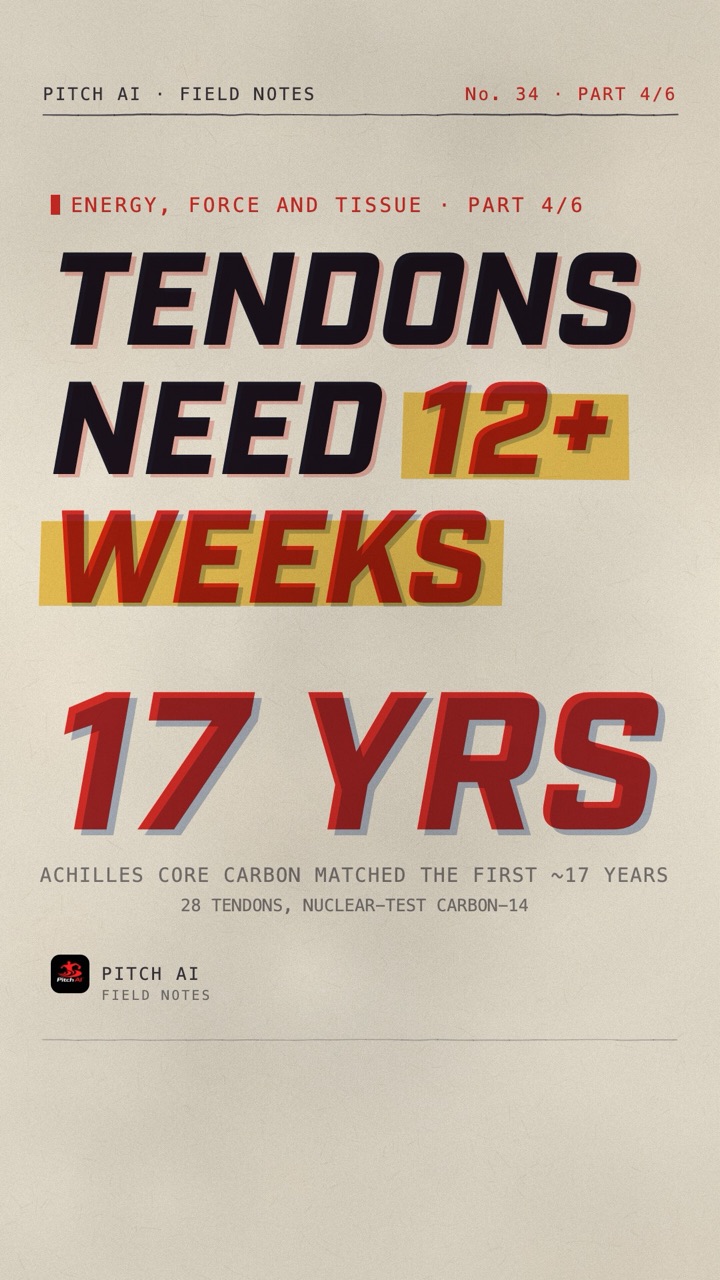
The deeper reason is turnover. Katja Heinemeier and colleagues used carbon-14 left in the atmosphere by nuclear weapons tests in the 1950s and 1960s as a time stamp. In 28 adult Achilles tendons, the carbon in the tendon core matched the air from roughly the first 17 years of each person's life. The core of the tendon is built while you grow and is essentially not renewed afterward, while muscle samples showed constant turnover [4]. Adult tendons still adapt, as the training studies below show, but the process is slow.
Does a tendon get thicker or stiffer?
Adam Bloebaum, writing for throwers, separates two adaptations [1]. A thicker tendon has more cross-sectional area, which spreads stress over more tissue. A stiffer tendon stretches less under the same load, which lets it pass force to the bone faster. Blazevich describes tendons as springs that store energy when stretched and recoil faster than muscle can shorten [6], which is part of why they matter so much in a throw.
In the research, stiffness is the bigger change. The 2015 meta-analysis by Sebastian Bohm, Falk Mersmann and Adamantios Arampatzis found an average effect size of 0.70 for stiffness and 0.69 for the tendon's material quality, but only 0.24 for its cross-sectional area [2]. Training seems to improve what the tendon is made of more than how big it gets.
How heavy does tendon training need to be?
Heavy. That is the clearest finding in the field. In Bohm's subgroup analysis, programs loading above about 70% of maximal strength produced a large stiffness effect (0.90). Lighter programs produced essentially none (0.04) [2]. The NSCA's Essentials of Strength Training and Conditioning makes the same point with one study. Loads around 80% of a one-rep max increased tendon stiffness and loads around 20% did not, and Achilles stiffness rose 15% to 19% after eight weeks of resistance training in another [7].
Do isometrics work for tendons?
Yes, if they are hard. When loading was heavy, the type of contraction made no significant difference. Heavy isometric holds, normal lifting and lowering, and lowering-only work all produced similar stiffness gains [2]. That makes a hard isometric a practical tendon tool for pitchers, because it lets you put high force through the tissue without fast, jarring movement.
Mersmann and colleagues describe a youth tendon program built on this idea. Five sets of four contractions at 85% to 90% of maximal isometric effort, each giving about three seconds of high tendon strain [5].
Build capacity first
Ramp your workload the smart way
Pitch AI ramps your throwing workload gradually and tracks how your arm responds, using your acute-to-chronic workload ratio and a daily Wellness Check-In.


Why teenage pitchers need to mind the gap
Muscle and tendon do not grow in step. Mersmann's review explains that muscle adapts faster and responds to more kinds of loading. Plyometric work, for example, seems to build muscle more than tendon. During adolescence, rising hormone levels can widen the gap, and a tendon that lags behind a fast-strengthening muscle sees higher strain [5]. The authors link this to the rise in tendon overload injuries reported in teenage athletes.
This is not a reason to train less. It is a reason to train in the right order. A teenager who adds jumps, sprints and harder throwing should also add heavy, slower loading so the tendons keep up. Combined with the carbon-14 finding that the tendon core is laid down during growth [4], it makes the teenage years a time to build robust tissue, not only peak output. Our guide to youth pitcher development covers the bigger picture.
What we do not know about throwing-arm tendons
Be honest about the limits. The meta-analysis included only Achilles and patellar tendons, in healthy adults aged 18 to 50 [2]. We do not have controlled training studies of the tendons around a pitcher's shoulder and elbow, and the UCL is a ligament, not a tendon. Ligaments share much of the same collagen biology, and Bloebaum argues that the same loading principles broadly apply [1], but that is an extension of the evidence, not a direct test.
The same caution applies to Bloebaum's idea for throwing implements. He suggests heavier balls early in the off-season to build a robust tendon, then lighter balls later to train stiffness and speed, and a mix of both for younger throwers [1]. It is a thoughtful application of force-time reasoning. It has not been tested in throwers. If you use weighted balls, our weighted ball guide covers dose and risk.
A 12-week tendon block for pitchers
This is an example template built from the principles above, not a prescription. Two to four heavy sessions a week covers the frequency most successful studies used [2].
| Weeks | Heavy and isometric work | Throwing |
|---|---|---|
| 1 to 4 | Learn the lifts. Isometric holds (split squat, forearm and grip holds, shoulder external rotation holds) building toward hard efforts, 2 to 3 times a week. | Return to throw or base catch play, volume rising gradually. |
| 5 to 8 | Heavy strength 3 to 5 reps above about 70% of max, plus 5 × 4 hard isometric holds of about 3 seconds, 2 to 4 times a week. | More distance and volume. Add intent slowly. |
| 9 to 12 | Keep heavy work and holds. Add jumps and med ball throws now that the base is built. | Higher intent days with lower days between them. |
Keep the heavy tendon work on the same days as hard throwing or lifting so easy days stay easy, and use a ramped workload so each week asks only a little more than the last. Our article on how to progress a throwing program shows how to build that ramp.
Common mistakes
- Judging the tendon by how strong you feel: muscle and nerve gains in the first weeks can outrun the tendon.
- Going light for "tendon health": light bands and easy reps do not change stiffness much. The tendon needs heavy force.
- Giving up at six weeks: most of the studies that worked lasted 8 to 14 weeks.
- Loading through pain: heavy loading is for healthy tissue. Pain at the elbow or shoulder means stop and see a clinician.
More from the Energy, Force and Tissue series
This article is part 4 of our Energy, Force and Tissue series. Each part takes one idea from physics or tissue science and turns it into a training decision.
- Part 1: How much energy is in a 100 mph fastball?
- Part 2: Does your arm create velocity or pass it on?
- Part 3: What is impulse and why does it matter for pitchers?
- Part 5: Should pitchers back squat?
- Part 6: Does your infrasternal angle decide your pitches?
Frequently asked questions
How long does it take for tendons to get stronger?
Usually two to three months or more. Most successful tendon training studies ran 8 to 14 weeks, and a 2015 meta-analysis recommends heavy loading for more than 12 weeks [2].
What kind of exercise strengthens tendons?
Heavy loading, above about 70% of maximal strength. Heavy isometric holds, normal lifting and lowering-only work all worked similarly well, while light loading produced almost no change in stiffness [2].
Do tendons adapt slower than muscle?
Yes. Strength can rise within weeks, largely from nervous system changes, while measurable tendon changes take months. In teenagers, muscle can outpace tendon and raise tendon strain [5, 7].
How long does collagen synthesis stay elevated after exercise?
Collagen building in tendon peaks around 24 hours after exercise and stays raised for about three days. Collagen breakdown also rises but peaks earlier [3].
Are isometrics good for pitchers?
Hard isometric holds are a practical way to load tendons heavily without fast movement. They worked as well as other contraction types in tendon research, but no study has tested them on pitchers specifically [2].
Tendons take months
Give them a plan that lasts that long
Pitch AI ramps your throwing workload gradually and tracks how your arm responds, alongside strength plans built for your level. Your daily Wellness Check-In logs arm freshness, soreness and any pain.
References
- Bloebaum A (2025). Tendon Adaptations in Throwers: Mechanisms and Applications. Practitioner blog. https://www.adambloebaum.com/blog/tendon-adaptations-in-throwers/
- Bohm S, Mersmann F, Arampatzis A (2015). Human tendon adaptation in response to mechanical loading: a systematic review and meta-analysis of exercise intervention studies on healthy adults. Sports Medicine - Open, 1, 7. https://doi.org/10.1186/s40798-015-0009-9
- Magnusson SP, Langberg H, Kjaer M (2010). The pathogenesis of tendinopathy: balancing the response to loading. Nature Reviews Rheumatology, 6(5), 262-268. https://doi.org/10.1038/nrrheum.2010.43
- Heinemeier KM, Schjerling P, Heinemeier J, Magnusson SP, Kjaer M (2013). Lack of tissue renewal in human adult Achilles tendon is revealed by nuclear bomb 14C. FASEB Journal, 27(5), 2074-2079. https://doi.org/10.1096/fj.12-225599
- Mersmann F, Bohm S, Arampatzis A (2017). Imbalances in the development of muscle and tendon as risk factor for tendinopathies in youth athletes: a review of current evidence and concepts of prevention. Frontiers in Physiology, 8, 987. https://doi.org/10.3389/fphys.2017.00987
- Blazevich AJ (2017). Sports Biomechanics: The Basics. Optimising Human Performance, 3rd ed. Bloomsbury. Chapter 17.
- Haff GG, Triplett NT, eds. (2016). Essentials of Strength Training and Conditioning, 4th ed. NSCA, Human Kinetics. Chapters 2 and 5.