
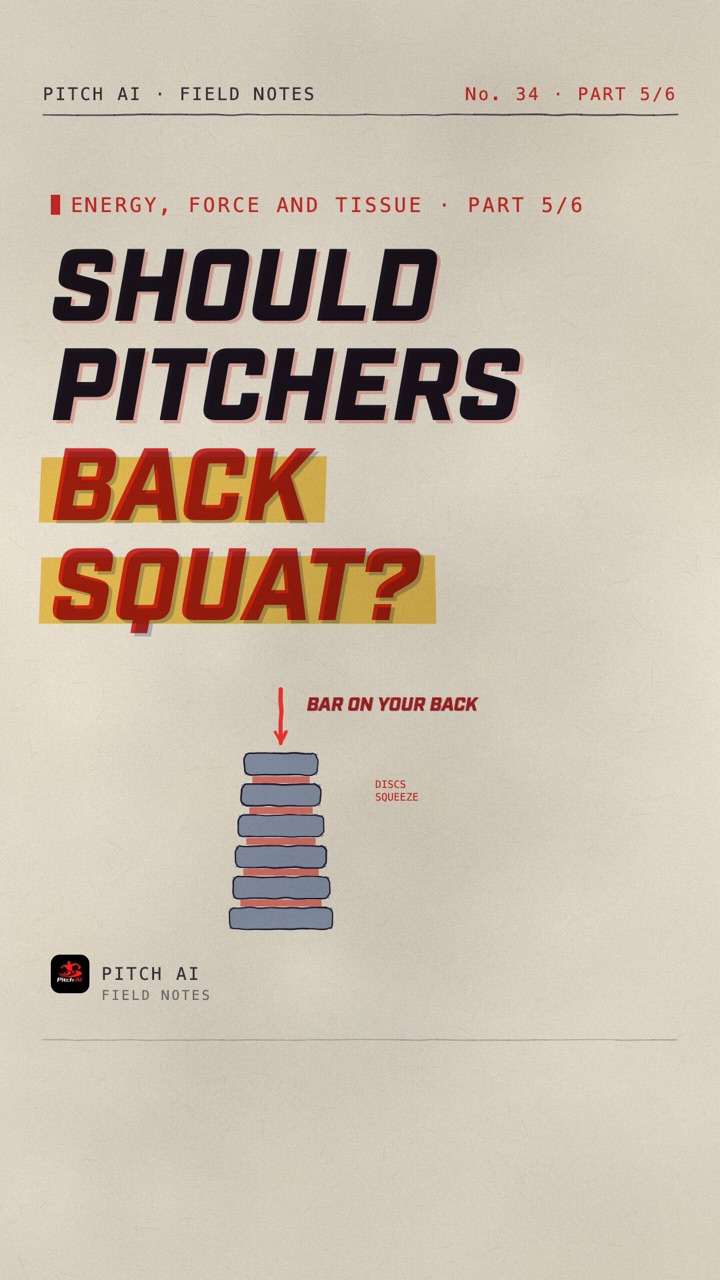
Pitchers can back squat, but whether they should depends on age, training history and the time of year. A heavy bar on your back loads the spine from above, which builds strength and toughness but also squeezes the spine's discs. For a young, untrained pitcher, taking a well-coached back squat from 135 to 250 pounds at modest volume is a worthwhile investment. For an advanced thrower, adding more spine compression to chase a bigger number is often not worth it, and the same leg strength can be built with less spinal load. That is the argument performance coach Brice Crider makes, and it lines up with what the research on spinal loading shows [1].
What is axial loading?
Axial load is force pressing along the long axis of your skeleton, mostly straight down the spine. A barbell on your back, a heavy deadlift and landing from a jump all create it. Crider defines the goal of heavy axial training as building strength in the muscles around the spine while also building tolerance for the axial forces a thrower meets on the field, then warns that "the dose and timing make the poison" [1].
How much does lifting compress the spine?
Enough to measure with a tape. In a 1986 study, Peter Leatt, Thomas Reilly and John Troup used standing height as a gauge of spinal shrinkage. Ten men lost an average of 5.4 mm of height from two rounds of a weight-training circuit. Nine novice runners lost 3.25 mm over a 6 km run. For comparison, normal daily life shrank people by about 14.4 mm from morning to evening, and the loss reversed overnight [2].
Height loss comes mostly from the discs. Zatsiorsky and Kraemer explain that a young disc's jelly-like center is up to 85% water, and that compression pushes fluid out while rest lets it back in [3]. None of this means lifting is dangerous. Daily life squeezes you more than one circuit did. It means axial load is a real stress with a recovery cost, like throwing, and it belongs in the plan on purpose rather than by default.
Spinal engine theory in plain words
In 1985, Serge Gracovetsky proposed that the spine is not just a pole that holds you up. In his view, its bending and twisting help power movement itself, like an engine in the middle of the body [4]. It is a theory, not a settled fact, but it has become popular in performance circles.
Crider applies it to throwing. He sees two camps. One says energy starts at the ground and travels up through the legs, with the spine as a bridge. The other says the spine and ribcage create much of the energy and the limbs amplify it. Crider thinks both are partly right. In his model, well-timed ground forces through the legs give the pelvis a stable base, and the spine and ribcage twist and bend segment by segment to build and pass energy toward the arm [1].
Why a thrower's ribcage needs to move
The 12 thoracic vertebrae connect to the ribs, and the joints there allow more rotation and side bending than the lower back does. For the shoulder blade to glide around the ribcage as the arm comes through, the ribcage has to change shape, squeezing on one side and opening on the other [1].
Here is where Crider makes his most interesting claim. He tested world-class powerlifter Chris Duffin on an isometric mid-thigh pull at Driveline and found Duffin's force numbers in the same range as his own, even though Duffin can squat and deadlift far more. His hypothesis is that years of maximal spinal loading turned Duffin's ribcage into something like a rigid cylinder, ideal for bracing under huge loads and the opposite of what a thrower needs [1]. Treat that as an expert hunch from one comparison, not a tested finding. It still raises a fair question. If an adaptation helps a lifter brace, does it help a pitcher rotate?
Strength that serves the throw
Get one plan for lifting and throwing
Pitch AI builds your strength, workload and velocity work into one plan around your season, so heavy lifting peaks when throwing is light and tapers as games get closer.


Dose axial load by age and training history
Crider's two examples make the idea concrete. A 17-year-old who takes a well-executed back squat from 135 to 250 pounds at reasonably low volume is making a worthwhile investment and is unlikely to build anything that hurts his throwing. A 23-year-old pitcher spending a lot of his training budget to move a trap bar deadlift from 600 to 650 pounds is probably doing himself a disservice [1].
Ben Brewster of Tread Athletics makes a similar point from the strength side. A novice pitcher who can barely squat his body weight needs to get genuinely strong first, and fast, light, explosive work pays off most for athletes who are already strong [6]. In other words, heavy basic strength matters most early in a training career. The underlying rule is the one Crider states. Use the least heavy spinal loading that builds a strong, skillful athlete, and judge every lift by whether the throw keeps improving.
How should pitchers periodize axial load across the year?
Within a training year, Crider puts more axial loading early in the off-season, when building strength and robustness is the priority, then tapers it as throwing volume and intensity rise toward the season [1].
Tapering is not going soft. Crider is clear that you still train big forces. You just get them from lower body jumps and bounds, and from heavy lifts that load the legs hard while sparing the spine [1].
Back squat alternatives for pitchers
Crider's two favorite heavy lower body options with little axial load are the belt squat and the leg press [1]. Tread's in-season template also programs the belt squat [5]. Eric Cressey adds a shoulder reason to skip the back squat with pitchers. Holding the bar asks for a lot of external rotation at the shoulder, and widening the grip to ease that lifts the arm toward a pinched position [7]. The ratings below are practical judgment, not lab measurements:
| Exercise | Spine load | Leg load | Notes |
|---|---|---|---|
| Back squat | High | High | Useful early in a young athlete's career. Shoulder position is a concern for some pitchers. |
| Trap bar deadlift | Moderate to high | High | Hands at the sides, so no shoulder strain from holding a bar. |
| Rear-foot elevated split squat | Lower | High per leg | Heavy loads per leg with less total weight on the spine. |
| Belt squat | Low | High | Load hangs from the hips. A Crider favorite. |
| Leg press | Low | High | Heavy leg work with the back supported. |
| Jumps and bounds | Brief, high | Fast force | Trains big ground forces in a short time. See part 3 on impulse. |
Whatever you pick, Brewster's rules from Building the 95 MPH Body apply. Train through a full range you can control, stop short of the lower back rounding at the bottom of a squat, and rotate variations across days or blocks [6]. Crider also warns against lifts that pile on spinal compression while giving the legs little real work, such as very heavy partial movements. In his words, the juice is not worth the squeeze [1].
Keep the spine moving
If the spine helps power the throw, it needs range as well as strength. Crider's recipe is high-intent training through as much range of motion as possible, blended with calmer work that teaches you to relax into end ranges of spinal flexion, extension and rotation. He adds that the most specific way to train your spine for throwing is still to throw [1].
A sample lower body day (example template, not a prescription)
- Early off-season, younger lifter: box jumps 3 × 3, back squat or trap bar deadlift 3 × 5 at a weight you can own, split squat 3 × 6 per leg, then trunk rotation work.
- Late off-season or experienced lifter: bounds 3 × 3, belt squat or leg press 3 × 5 heavy, single-leg work 3 × 6, then full-range spinal mobility.
- In season: short jumps, one heavy low-spine-load lift for 2 to 3 sets, done well away from start day.
For where these days sit in the bigger picture, see how to plan a pitcher's off-season.
Common mistakes
- Treating the squat number as the goal: the goal is more force in the throw. Lifts are support work.
- Banning heavy lifting: young pitchers usually have the most to gain from getting genuinely strong.
- Never tapering: the same heavy spine loading all year leaves less recovery for throwing when it matters most.
- Ignoring back pain: discomfort that lingers after lifting is a reason to change the plan and see a clinician, not to push through.
More from the Energy, Force and Tissue series
This article is part 5 of our Energy, Force and Tissue series. Each part takes one idea from physics or tissue science and turns it into a training decision.
- Part 1: How much energy is in a 100 mph fastball?
- Part 2: Does your arm create velocity or pass it on?
- Part 3: What is impulse and why does it matter for pitchers?
- Part 4: How long does it take tendons to get stronger?
- Part 6: Does your infrasternal angle decide your pitches?
Frequently asked questions
Should pitchers do back squats?
They can, with some care. A young, untrained pitcher building a solid back squat at modest volume is making a good investment. Advanced throwers often get the same leg strength with less spinal load from belt squats, leg presses and split squats [1].
What is axial loading?
Axial loading is force pressing along the length of the spine, such as a barbell on your back. It builds strength and tolerance but compresses the spinal discs [1, 3].
Does lifting weights make your spine shorter?
Temporarily. In one study, a weight-training circuit reduced standing height by about 5.4 mm, while normal daily activity reduced it by about 14.4 mm. The loss reversed overnight [2].
What is spinal engine theory?
It is the idea, proposed by Serge Gracovetsky in 1985, that the spine helps power movement rather than only supporting the body. It is a theory, not a settled finding [4].
Dose it by season
Let the plan do the periodizing
Pitch AI builds your strength, workload and velocity work into one plan around your season, with strength plans for your experience level and a velocity trend to show what is working.
References
- Crider B. Spinal Engine Theory and Periodization of Axial Load for the Throwing Athlete. Crider Performance blog (practitioner article). https://www.bricecrider.com/blog/periodizing-axial-load-for-the-throwing-athlete
- Leatt P, Reilly T, Troup JDG (1986). Spinal loading during circuit weight-training and running. British Journal of Sports Medicine, 20(3), 119-124. https://doi.org/10.1136/bjsm.20.3.119
- Zatsiorsky VM, Kraemer WJ (2006). Science and Practice of Strength Training, 2nd ed. Human Kinetics. Chapter 7.
- Gracovetsky S (1985). An hypothesis for the role of the spine in human locomotion: a challenge to current thinking. Journal of Biomedical Engineering, 7(3), 205-216.
- Brewster B. In-Season Training Blueprint. Tread Athletics (practitioner guide, undated).
- Brewster B (2015). Building the 95 MPH Body. Tread Athletics. Chapters 2 and 6.
- Cressey E. Back Squats and Overhead Throwers. Cressey Sports Performance blog (practitioner article). https://ericcressey.com/back-squats-and-overhead-throwers/