
Probably not. The infrasternal angle (ISA) is the angle where your lower ribs meet at the bottom of your breastbone, and a popular coaching model uses it to sort athletes into "wide" and "narrow" types with different movement styles and pitch shapes. The angle can be measured consistently. But there is no peer-reviewed evidence that ISA-based tests predict how you move or which pitches you can throw, and the coaching book that teaches those tests says so itself [2]. Bodies also change with training. A label describes where you are today, not your ceiling.
What is the infrasternal angle?
Find the bottom tip of your breastbone. The lower ribs angle away from it on each side, down and out, like an upside-down V. The angle between those two rib edges is the infrasternal angle. The lowest ribs are joined by cartilage rather than attached firmly to the breastbone, so this part of the ribcage is the most changeable part of the trunk. Clayton Thompson, a pitching coach, describes these "bucket handle" ribs as the most pliable section of the axial skeleton [1], and Pat Davidson calls them extremely malleable [2].
What does the ISA model claim?
Thompson credits the model to Bill Hartman, and it has spread widely in baseball. In the version Thompson describes, a wide angle (over about 110 degrees) signals a ribcage biased toward exhaling and compression, with internal rotation tendencies. A narrow angle (under about 100 degrees) signals a bias toward inhaling and expansion, with external rotation tendencies [1]. Coaches then link each type to delivery styles and pitch shapes.
Even the cut-offs are not agreed. Davidson's book, which teaches a related assessment, uses different numbers [2]:
| Source | Narrow | Middle or ideal | Wide |
|---|---|---|---|
| ISA model as described by Thompson | Under about 100° | Not given | Over about 110° |
| Davidson, A Coach's Guide to Optimizing Movement | 75° or less | 108.8° | 135° or more |
Davidson derives his 108.8 degree "ideal" from the geometry of a double helix, a theoretical argument rather than a measurement of athletes [2]. When two sources disagree this much on where the categories start, it is a sign the categories are softer than they sound.
What does the evidence actually show?
Two separate questions get mixed up. The first is whether you can measure the angle reliably. The second is whether the angle predicts anything useful about a pitcher.
On measurement, a 2015 study by Moon-Hwan Kim and Jong-Hyuck Weon had raters measure the angle from photographs of 24 healthy male college students. Agreement within and between raters was good to excellent at rest, with intraclass correlations of about 0.81 to 0.92 [3]. So the number itself can be repeatable.
On prediction, the evidence is missing. Davidson writes plainly that "there is no peer-reviewed evidence to indicate whether these tests are reliable and valid for this process," and calls testing them with scientific rigor a current limitation of a very young model [2]. A search of the research turns up studies on pitch types and studies on rib angles, but none that link the two. That does not prove the model wrong. It means nobody has shown it is right.
Bones and ribs adapt to how you train
Skeletons respond to load over time. The clearest example in baseball is the upper arm bone. Haydn Crockett and colleagues CT-scanned 25 professional pitchers and 25 non-throwers. The pitchers' throwing-arm humerus was twisted further back (more humeral retroversion) than their other arm, along with more external rotation, while the non-throwers showed no difference between arms [4]. Years of throwing changed the shape of the bone.
Thompson argues the lower ribs can change too, and much faster. He describes Rob Hill, a pitcher who trained at Driveline and went from the low 90s to the mid 90s. Hill's ribcage got wider while he was putting on weight in a heavy lifting phase and narrower when he leaned out during a phase of faster, peak-force training [1]. That is one athlete's story, not a study, but it makes Thompson's point well. In his reading, the angle reflected how Hill was training rather than causing how he threw.
Davidson, interestingly, lands close to the same place. He writes that the resting angle matters less than whether an athlete can change it, and that a dynamic angle is a better sign than any perfect static number [2].
Test, do not assume
Find out what your hand can do
Pitch AI's Pitch Lab logs every grip change, so you can see what it did to the shape instead of guessing from a body type.


Why labels can hold pitchers back
The bigger risk is not a wrong number. It is a closed door. Thompson's example is the line "you're a supinator, so you can't throw a riding fastball, throw a sinker instead." His answer is no. Some athletes are more inclined toward certain pitch shapes with the movement they have today, but if you give a pitcher more movement options, that pitcher can throw more pitches [1].
Rob Gray, a perception and motor learning researcher, makes the same point in general terms. Individual constraints such as strength, speed and range are not fixed. Training them can create movement solutions that were not available before [6]. A label treats an individual constraint as permanent. Training treats it as a starting point.
Is how you apply force a better question?
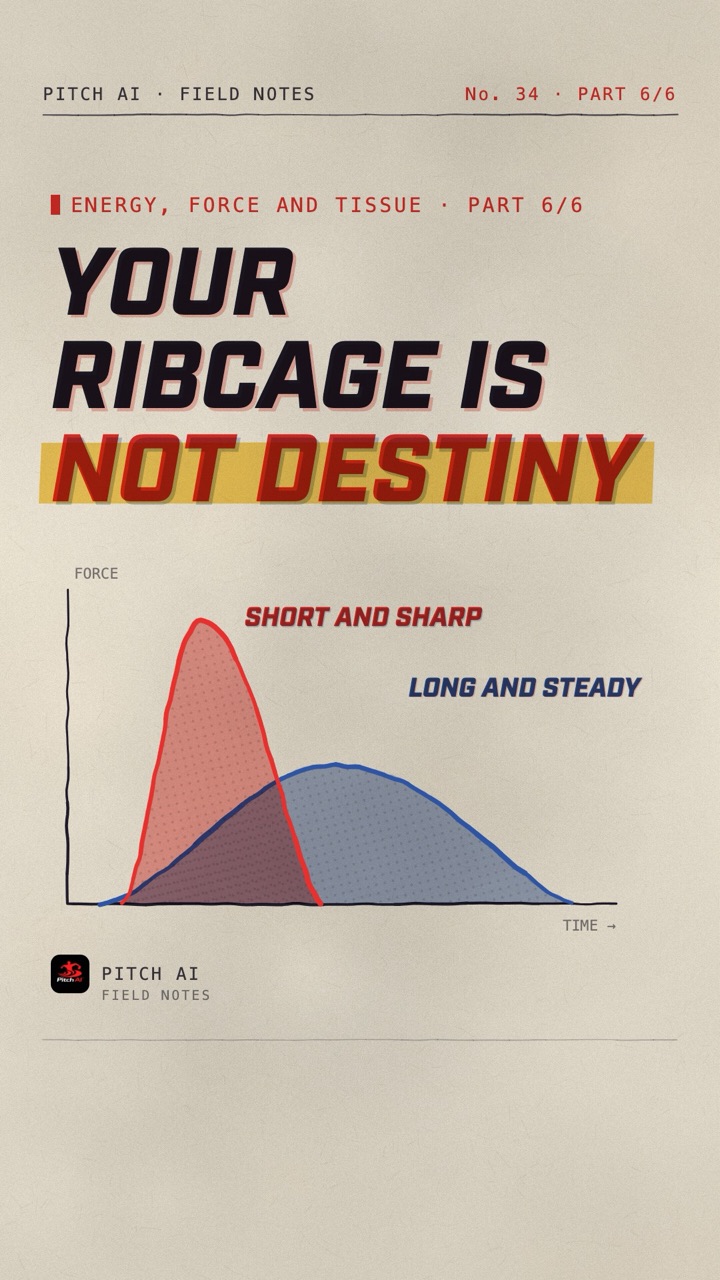
Thompson proposes looking at force instead of rib shape. Every pitch hands the ball the same physics problem, a set amount of impulse to reach a given speed. One athlete may push long and steady, another short and sharp, and both can produce the same area under the force-time curve and the same velocity [1, 5].
Be honest about this idea too. Thompson's "long duration" and "short duration" impulse types are also a classification, and they are also untested. Some details he lists, such as how long a one-rep max takes or the sound a foot makes on landing, are observations rather than measured findings. The advantage he claims is that force profiles can be measured and trained, so the category is a description of current tendencies rather than a verdict. That is a reasonable advantage, but it still needs to be checked against data. Part 3 of this series explains what impulse is and how to train it.
What to do instead of an ISA label
- Measure outputs first: velocity, pitch movement and simple jump tests tell you what an athlete does now. Crider argues coaches too often start with anatomy and never quantify outputs [5].
- Train both ends of the force curve: heavy strength for peak force, jumps and med balls for fast force.
- Expand range where it is missing: Thompson suggests that limited forearm supination or pronation can restrict pitch options, and that opening up that range may add pitches [1].
- Test shapes instead of assuming them: try the riding fastball, the sinker and the sweeper, and let the movement numbers decide. Our guides on pitches by arm slot and adding a second fastball shape show how to judge them.
- Use constraints to explore: varied targets, ball weights and drills let an athlete find new solutions. See the constraints-led approach in pitching.
Common mistakes
- Treating a resting measurement as destiny: even the people who teach the angle say the ability to change it matters more [2].
- Building an arsenal from a body type: pitch shapes come from release, spin and grip, which you can test directly.
- Swapping one rigid label for another: any classification, including force profiles, should be a starting guess you update with data.
- Ignoring the useful part: breathing and ribcage mobility work may still help some athletes move better. The problem is using the angle to close options, not paying attention to the trunk.
More from the Energy, Force and Tissue series
This article is part 6 of our Energy, Force and Tissue series. Each part takes one idea from physics or tissue science and turns it into a training decision.
- Part 1: How much energy is in a 100 mph fastball?
- Part 2: Does your arm create velocity or pass it on?
- Part 3: What is impulse and why does it matter for pitchers?
- Part 4: How long does it take tendons to get stronger?
- Part 5: Should pitchers back squat?
Frequently asked questions
What is the infrasternal angle?
It is the angle formed where the lower ribs meet at the bottom of the breastbone. Some coaching models use it to classify athletes as wide or narrow and link each type to movement and pitch tendencies [1].
Does the infrasternal angle determine what pitches you can throw?
There is no peer-reviewed evidence that it does. Even the coaching book that teaches ISA-based tests states that their reliability and validity for this purpose have not been shown [2].
What is a wide versus narrow infrasternal angle?
In the version of the model Thompson describes, wide is over about 110 degrees and narrow is under about 100 degrees. Davidson uses different cut-offs, with 108.8 degrees as ideal, so the categories are not standardized [1, 2].
Can your infrasternal angle change?
It appears so. The lower ribs are joined by cartilage and are the most changeable part of the ribcage, and coaches report the angle shifting with body mass and training. Davidson argues the ability to change it matters more than its resting value [1, 2].
Can the infrasternal angle be measured reliably?
In one small study of 24 male college students, photo-based measurements were repeatable, with intraclass correlations around 0.81 to 0.92 at rest [3].
Labels describe today
Build the arsenal the data supports
Pitch AI's Pitch Lab logs every grip change, so you can see what it did to the shape, and your strength plans and velocity trend show how your force output is changing.
References
- Thompson C. The Case Against ISA: A Better Classification System for Pitchers. Medium (practitioner essay). https://medium.com/@cl4ytonthompson/the-case-against-isa-d4f08e47e976
- Davidson P. A Coach’s Guide to Optimizing Movement: Rethinking the Big Patterns. Chapter 5, pp. 63-65.
- Kim M-H, Weon J-H (2015). Intra- and inter-rater reliabilities of infrasternal angle measurement. Korean physical therapy journal (24 healthy male college students). https://www.koreascience.or.kr/article/JAKO201524453729557.page
- Crockett HC, Gross LB, Wilk KE, et al. (2002). Osseous adaptation and range of motion at the glenohumeral joint in professional baseball pitchers. American Journal of Sports Medicine, 30(1), 20-26. https://doi.org/10.1177/03635465020300011701
- Crider B. Impulse: The King of Performance Metrics. Crider Performance blog (practitioner article). https://www.bricecrider.com/blog/impulse-the-king-of-performance-metrics
- Gray R (2021). How We Learn to Move: A Revolution in the Way We Coach and Practice Sports Skills. Perception Action Consulting and Education. Chapter 4.